Exponential models (and linear models) are very useful for making predictions in the real world. However, they’re a bit limited — there are only a few shapes they can take. Scientists and mathematicians have figured out lots of other kinds of models that have wigglier shapes and are better able to predict other kinds of situations. Without getting bogged down in the details, we’ll learn about two more of them in this chapter.
A flu virus has been spreading through the college dormitories. Initially 8 students were diagnosed with the flu, but that number has been growing rapidly. After 2 weeks, there were 64 students with the flu. We are interested in predicting how many students will catch the flu over the next 6 weeks or so. To get a sense of scale, there are 1,094 students currently living in the dorms.
\begin{align*}
F \amp= \text{ total number of students with the flu (students) } \sim \text{ dep} \\
D \amp= \text{ time since first cases (days) } \sim \text{ indep}
\end{align*}
And here is the initial data:
\(D\)
0
14
\(F\)
8
64
(If this story sounds familiar, it’s because the story also appears in the practice exercises 3 and 2.)
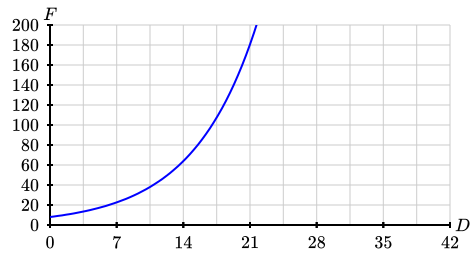
We’ll start with an exponential model, since that’s the kind of equation that we’ve been learning about in this chapter. Using the methods from Section 5.3, we can find that the growth factor \(g = 1.16\text{,}\) or in other words, that the number of students diagnosed with the flu was growing 16% per day. The corresponding exponential equation is
\begin{equation*}
\textbf{exponential:} \quad F = 8 \ast 1.16^D\text{.}
\end{equation*}
While at first the exponential model seems reasonable, it quickly gets too large to make sense. After all, there are only 1,094 students currently living in the dorms so the numbers we found at 5 and 6 weeks (also known as 35 and 42 days) are totally unrealistic. The exponential model is based on the assumption that the rate of change of the number of new cases is proportional to the number of infected students: those who already have the flu.
There are both advantages and disadvantages of the exponential model. To its credit, the exponential model captures the reality of the first few weeks, where the flu spreads very rapidly. But, the exponential model misses several basic facts. First, as more students catch the flu, the number of new cases decreases in part because sick people are already surrounded by sick people so there aren’t new people to get sick. Second, for whatever reasons, not everyone is going to catch the flu no matter how exposed they are. We would like to have an alternative model that keeps what works (rapid increase at first) but deals better with the long term (the growth slows down and not everyone catches the flu).
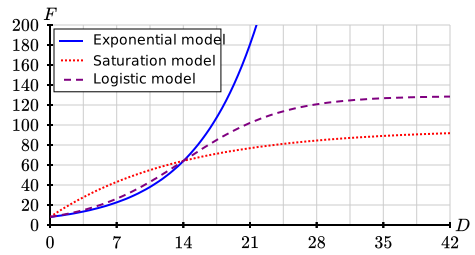
The first example is a saturation model. Basically it assumes that the rate of change of the number of new cases is proportional to the number of susceptible students: those who are likely to catch the flu but haven’t already. Since at the beginning many susceptible students don’t have the flu, it spreads very quickly, even faster than the exponential does. But once most susceptible students have caught the flu, the number of new cases dwindles.
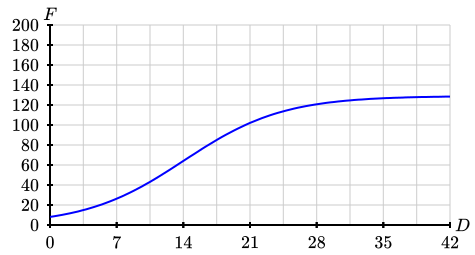
The second example is a logistic (or S-curve) model. Basically it assumes that the rate of change of the number of new cases is jointly proportional to the number of infected students and the number of susceptible students. It acknowledges the heavy influence the number of infected students have initially on the growth, but balances it with the limiting influence of the diminishing number of susceptible students over time.
Notice how we need parentheses around the bottom of our fraction, as usual, to override the normal order of operations. We rounded the numbers in the table to the nearest person.
The logistic model projects that 128 students (total) will have (or have had) the flu over the next 6 weeks, considerably more than projected by the saturation model.
As you can see from the graph, one key feature of both the saturation and logistic curves is that they level off. One way to estimate those limiting values (or carrying capacity) is to evaluate the functions at large values, say 60 days, 100 days, and (the unrealistic) 1,000 days.
We crossed out the unrealistic values from the exponential equation. So, if the saturation model is accurate, then we should expect around 96 total cases. But, if the logistic model is accurate, then we should expect around 129 total cases instead.
Corn farmers say that their crop is healthy if it is “knee high by the Fourth of July.” An equation modeling the height \(H\) (in inches) of the corn crop \(T\) days since May 1 is
With stronger corn these days, the rule ought to be “chest high (52 inches) by the Fourth of July.” According to this equation, approximately when is the corn projected to be that tall? Use successive approximation to answer.
According to this new equation, on approximately what date is the corn projected to be “chest high” (52 inches tall)? Use successive approximation to answer.
Back in 1975 when my aunt and uncle bought their house in upstate New York, there was a small pond in the yard. They enlarged it and stocked it with 10 small fish. The number of fish \(F\) increased over time, approximately according to the equation
By the time there were over 500 fish in the pond, you could catch them with your bare hands. In approximately what year did that happen? Use successive approximation.
Jason works at a costume shop selling Halloween costumes. The shop is busiest during the fall before Halloween. An equation that describes the number of daily visitors \(V\) the shop receives \(T\) days from August 31 is the following:
Mari volunteers answering calls for in the office of her local state government representative. The office has been receiving a lot of calls recently with about BPA, a chemical found in plastics. The callers want their representative to support a bill banning BPA. An equation that describes the number of total number of calls over time is the following:
According to this equation, how many calls (total) will Mari’s office get by February 1 (day 31), March 1 (day 59), April 1 (day 90), May 1 (day 120), and Nov 8 (day 311)?
Even though all the callers support the bill, Mari isn’t sure whether the calls represent the local constituents. Perhaps only supporters are calling her office, for example. So, she asks her pollster, Paul, to add this question to the list for his daily survey. Based on that survey, Paul estimates the percentage \(P\) of local constituents who support the bill on day \(D\) by the equation
\begin{equation*}
P =100 - 87.3 \ast 0.992^D
\end{equation*}
According to this equation, what percentage of callers supported the bill on January 1 (day 0), March 1 (day 59), Aug 1 (day 212), Oct 1 (day 273) and Nov 8 (day 311)?
Infants are regularly checked to make sure they are growing accordingly. The World Health Organization publishes growth charts to evaluate infant weight \(W\) in kilograms at a given age \(M\) in months since birth. An equation that describes an average infant boy is the following:
The equation is valid for \(0 \le M \le 36\text{,}\) or up to three years old. Draw a graph that includes your points from earlier and the values at 3, 4, 5, and 6 years. Can you explain why the equation doesn’t make sense after around 3 years?
The lake by Rodney’s condo was stocked with bass (fish) 10 years ago.
Aside
There were initially 400 bass introduced. The carrying capacity of the lake is estimated at 4,000 bass. Two potential models for the number of bass (\(B\)) over time, where \(Y\) measures the years from when the lake was stocked 10 years ago are
Make a table showing the bass population projected by each model, including 10 years ago, now, in 10 more years, in 20 more years, and in 30 more years.