Logo image

Just Enough Algebra 2026 Edition

Section 2.2 A first look at exponential equations

Linear functions arise naturally whenever we think of constant growth. In this section we’ll think about another very common type of function which arises naturally whenever we think of percent growth.

Opening Activity 2.2.1.

Percents are always of something — they are a part of some whole. For example, in a previous section, a report said that the average price of gasoline in Minnesota increased approximately 20% per year. If we were being very careful, we would say that this is 20% of the current price each year.
For each of the percentages listed below, write a few words describing what the whole whould be.
  1. In a recent game against the Golden State Valkyries, Minnesota Lynx star Napheesa Collier’s field goal percentage was 72.7%. This means that she made 72.7% of .
  2. If you sign up for an online store’s mailing list, you will receive a coupon for 15% off one item. This means that your discount amount is 15% of .
  3. In a particular math class, I observed that the number of students with brown hair was 65% of .
The moral of this story: Any time you see some percentage, like 68%, you should ask, “68% of what?

Subsection Percents of different wholes

Jocelyn got a job right out of college, as an administrative assistant earning $28,000 a year. The position turned out to be a great fit for her, and after one year she was promoted to data analyst with a 15% raise. The next year Joceyln was promoted again, to senior data analyst along with a 21% raise. “Not bad,” her friend Audun said, “a 36% raise in two years.” But Jocelyn quickly corrected him. “Audun, it’s even better than that! It’s over 39%!”
After the first year, Jocelyn’s salary of $28,000 was increased by 15%. Remember that means that her raise was 15% of $28,000. To calculate 15% of $28,000 we multiply using the decimal form
\begin{equation*} 15\% = \frac{15}{100} = 15 \div 100 = 0.15 \end{equation*}
to get
\begin{equation*} 15\% \text{ of } 28{,}000 = 0.15 \times 28{,}000 = 4{,}200 \end{equation*}
That’s how much Jocelyn’s raise was that first year. By adding that amount to the original salary we get
\begin{equation*} 28{,}000 + 4{,}200 = 32{,}200 \end{equation*}
After one year Jocelyn’s salary was $32,200.
After the second year, Jocelyn got a 21% raise. But 21% of what? This means her salary rose by 21% from what it was just before the raise, that is, from the $32,200. (The 21% does not refer back to the original $28,000 value!) So, to calculate the second increase, we take 21% of $32,200, which is
\begin{equation*} 21\% \text{ of } \$32{,}200 = 0.21 \times 32{,}200 = \$6{,}762 \end{equation*}
By adding on this raise we get
\begin{equation*} 32{,}200+ 6{,}762 = 38{,}962 \end{equation*}
After the second year Jocelyn was earning $38,962.
Since Jocelyn’s original salary was $28,000, the net increase in her salary is the difference
\begin{equation*} \$38{,}962 - \$28{,}000 = \$10{,}962 \end{equation*}
The corresponding percentage increase was
\begin{equation*} \frac{10{,}962}{28{,}000}= 10{,}962 \div 28{,}000 = 0.3915 = 0.3915 \times 100\% = 39.15\% \end{equation*}
As Jocelyn said, that’s an increase of over 39% of her original salary.
What’s going on here? Audun thought that 15% and 21% would be 36% because \(15 + 21 = 36\text{.}\) The reason it doesn’t work that way is that while the 15% is of the original $28,000, the 21% is of the $32,200. So, we can’t just combine percentages by adding, because the wholes might be different.

Subsection A one-step process for finding percent change

Each time we figured out Jocelyn’s new salary, we did a two-step process. First, we calculated the amount of the increase, and second, we found the new value by adding on. There’s actually an easier way.
Jocelyn’s salary was $28,000 and then went up by 15%. For her new salary we want to add her old salary (all of it) plus 15%. So we want 100% of her old salary plus 15% of her old salary. Since we are finding two percents of the same whole, we can add the percents together: in this case, we can compute 115% of her old salary.
That works in general. When we increase a number by 15%, we end up with 100% of what we started with plus 15% more of what we started with, for a grand total of 115% of what we started with. So we can just multiply by 1.15, which is 115% written in decimal, since
\begin{equation*} 115\% = \frac{115}{100} = 115 \div 100 = 1.15 \end{equation*}
Looks weird, works great.
That means all we have to do to find Jocelyn’s salary is
\begin{equation*} 28{,}000 \times 1.15 = 32{,}200 \end{equation*}
We can do the same thing for the next calculation:
\begin{equation*} 32{,}200 \times 1.21 = 38{,}962 \end{equation*}
Here we multiplied by 1.21 because after a 21% increase you have 121% of what you started with. And 121% in decimal form is just 1.21.
Now hang on to your hat, because we can combine these parts together. In our example, we started with $28,000. Then we multiplied by 1.15, which gave us $32,200. And then we multiplied that answer by 1.21, to get our final answer of $28,962. So really we just did
\begin{equation*} 28{,}000 \times 1.15 \times 1.21 = 38{,}962 \end{equation*}
Same answer. A lot less effort. And, check it out:
\begin{equation*} 1.15 \times 1.21 = 1.3915 =139.15\% \end{equation*}
That’s where the 39.15% increase is hidden. Cool.

Activity 2.2.2.

The comprehensive fee at a local private college is $64,000. The fee is projected to increase by 5.8% per year. Let’s test that the two-step method and the one-step method give the same result for the fee next year.
  1. First, let’s try this calculation the two-step way.
    1. Convert 5.8% into decimal form.
    2. Find the amount of this year’s increase by multiplying 5.8% in decimal by this year’s fee.
    3. Add the amount of increase to this year’s fee to find next year’s fee.
  2. Now let’s try it the one-step way.
    1. Explain why the new fee should be 105.8% of the old fee.
    2. Write 105.8% in decimal form.
    3. Find the new fee by multiplying 105.8% in decimal by this year’s fee.
  3. Did you get the same answer both ways? If not, check your work.
  4. Which way do you prefer? Why?

Subsection Growth rate and growth factor

Here’s a little vocabulary that will be very helpful for us moving forward. A percentage increase is known as the growth rate and the number we multiply in the one-step method is called the growth factor.

Aside

For example, in calculating 15% increase, the growth rate was \(15\%=0.15\) in decimal, and so the growth factor was
\begin{equation*} 115\%=1.15 \end{equation*}
If you’re into formulas here it is.

Percent Change Formula

If a quantity increases by a percentage corresponding to growth rate \(r\text{,}\) then the growth factor is
\begin{equation*} \displaystyle g=1+r \end{equation*}
For Jocelyn’s 15% raise, we had \(r=0.15\) and so
\begin{equation*} g=1+r=1+0.15=1.15 \end{equation*}
Or, in percent format, we had \(r=15\%\) and so
\begin{equation*} g=100\% + r = 100\% + 15\% = 115\% \end{equation*}
Let’s summarize all of this in a table, so you can see the connections between \(r\) and \(g\) in both the percent format and the decimal format.
Percent format Decimal format
Growth rate \(r\) \(15\%\) \(0.15\)
Growth factor \(g\) \(115\%\) \(1.15\)

Activity 2.2.3.

The comprehensive fee at a local private college is $64,000. The fee is projected to increase by 5.8% per year. Let’s identify the growth rate and the growth factor.
  1. What is the growth rate \(r\text{?}\) Write down your answer in both percent format and decimal format.
  2. What is the growth factor \(g\text{?}\) Write down your answer in both percent format and decimal format.
  3. Go back to your work in Activity 2.2.2. Identify all the places you used the growth rate \(r\text{.}\)
  4. Now identify all the places you used the growth factor \(g\text{.}\)

Subsection Using exponents to find multiple increases at once

Jocelyn’s most recent assignment has been analyzing information on rising health care costs. In 2007 the United States spent $2.26 trillion on health care. Written out with all its zeros that’s
\begin{equation*} \$2.26 \text{ trillion} = \$2{,}260{,}000{,}000{,}000 \end{equation*}
Health care costs were projected to increase at an average of 6.7% annually. That means we have
\begin{equation*} r= 6.7\% = 0.067 \end{equation*}
and
\begin{equation*} g=1+r=1+0.067=1.067 \end{equation*}
So, to find the effect of a 6.7% increase, we can just multiply by 1.067. Again, that’s the 100% of what we started with plus 6.7% more for a grand total of \(106.7\%= 1.067\text{.}\)
We are ready to do some examples. In 2007 the United States spent $2.26 trillion on health care. The projection for one year later is
\begin{equation*} 2.26 \times 1.067 = 2.41142 \approx \$2.41 \text{ trillion} \end{equation*}
Another year later, projected health care costs are
\begin{equation*} 2.41 \times 1.067 = 2.57147 \approx \$2.57 \text{ trillion} \end{equation*}
And so on. For each year we multiply by another 1.067.
For example, by 2017 (ten years later), health care costs are projected to be
\begin{equation*} 2.26 \times \underbrace{1.067 \times 1.067 \times 1.067 \times 1.067 \times 1.067 \times 1.067 \times 1.067 \times 1.067 \times 1.067 \times 1.067}_{10\text{ times}} \end{equation*}
I don’t know about you, but I would rather not type that all into a calculator — I’m worried that I would lose count of how many times I typed 1.067. Luckily, multiplying by 1.067 ten times is the same as multiplying by \(1.067^{10}\text{.}\) Recall that the base \(1.067\) is the number we multiply by and the exponent (or power) \(10\) tells us how many times. So we can calculate
\begin{equation*} 2.26 \ast 1.067^{10} = 2.26 \times 1.067 \wedge 10 = 4.322675488 \approx \$ 4.32 \text{ trillion} \end{equation*}
Notice that the order of operations is exactly what we wanted here: first raise 1.067 to the 10th power, then multiply by 2.26. So we can enter it all at once without needing parentheses. Bottom line: health care costs are expected to be around $4.32 trillion by the year 2017. Oh my!

Activity 2.2.4.

The comprehensive fee at a local private college is $64,000. The fee is projected to increase by 5.8% per year. Let’s use exponents to compute some projected future fees.
  1. What is the growth factor \(g\text{?}\) Give your answer in decimal form.
  2. What would \(64{,}000 \ast 1.058^5\) mean in this story?
  3. Use your calculator to figure out:
    • \(\displaystyle 64{,}000 \ast 1.058^{10}\)
    • \(\displaystyle 64{,}000 \ast 1.058^{20}\)
    • \(\displaystyle 64{,}000 \ast 1.058^{50}\)
    What would each one of these numbers mean in this story?

Subsection Generalizing to an equation

We’re so close to the equation for Jocelyn’s health care costs assignment now, we can smell it. Our variables are
\begin{align*} H \amp= \text{ health care costs (\$ trillions) } \sim \text{ dep} \\ Y \amp= \text{ time (years since 2007) } \sim \text{ indep} \end{align*}
We just found the cost after 10 years was
\begin{equation*} \$2.26 \ast 1.067^{10}\approx \$4.32 \text{ trillion} \end{equation*}
We can generalize to get the equation by putting in \(Y\) (instead of 10) and \(H\) (instead of $4.32 trillion). When we do, we get
\begin{equation*} 2.26 \ast 1.067^{Y} = H \end{equation*}
Rewriting the equation to begin with the dependent variable we get
\begin{equation*} H = 2.26\ast 1.067^{Y} \end{equation*}
By the way, there are two other standard ways of writing this equation
\begin{equation*} H= 2.26(1.067)^{Y} \quad \text{ and } \quad H = 2.26\left(1.067^{Y}\right) \end{equation*}
For example, in 2027 we have \(Y=2027 - 2007 = 20\) years and our equation projects health care cost at
\begin{equation*} 2.26 \ast 1.067^{20} = 2.26 \times 1.067 \wedge 20 = 8.821882053 \approx \$8.82 \text{ trillion} \end{equation*}
Not sure it’s realistic to expect that steady an increase for 20 years, but that is what the equation projects, so let’s work with it for now.
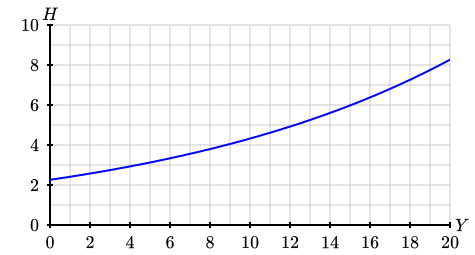
What does the graph of this function look like? Here are the values we found so far. That should be enough.
year 2007 2008 2009 2017 2027
\(Y\) 0 1 2 10 20
\(H\) 2.26 2.41 2.57 4.32 8.82
Health care costs vs time
Figure 2.2.1. \(H\) = healthcare spending as a function of \(Y\)= time since 2007.
Can you see that the graph curves slightly? It’s not a straight line. That’s because this function isn’t linear.

Activity 2.2.5.

The comprehensive fee at a local private college is $64,000. The fee is projected to increase by 5.8% per year. Let’s write an equation that describes this story.
  1. First, we have to name the variables.
    letter = everyday words (units) ~ dep or indep
    = \(\qquad\qquad\qquad\qquad\qquad\) \(\displaystyle\Big(\qquad\Big)\) ~
    = \(\displaystyle\Big(\qquad\Big)\) ~
  2. Generalize your calculations from Activity 2.2.4 to write down an equation.
  3. Summarize your calculations from Activity 2.2.4 in a table. Fill in your variable letter names.
    (indep) 0
    (dep) 64,000
  4. Draw a graph of these values, and connect them with a nice smooth curve.

Subsection A template for exponential equations

Look back at our equation
\begin{equation*} H = 2.26\ast 1.067^{Y} \end{equation*}
This type of equation is called an exponential equation because the independent variable is in the exponent. Any exponential equation fits this template.

Exponential Equation Template

\begin{equation*} \text{dep} = \text{start} \ast \text{growth factor} ^ {\text{indep}} \end{equation*}
Notice our two variables are in our equation and there are two constants. Each constant has its own meaning. The first constant is 2.26 and it is measured in trillions of dollars. It is the amount spent on health care in the starting year of 2007. In our standard form we refer to this quantity as the starting value (or start for short). As with linear equations, its official name is intercept and it’s the value where the curve crosses the vertical axis on the graph.
The second constant is the growth factor 1.067, and is the decimal equivalent of the 106.7%. The growth factor for an exponential equation is similar to the slope of a linear equation because both tell us how fast the function is increasing. But the slope measures the rate of change — how much is added at each step — while the growth factor corresponds to the percent increase. Another way to say that is linear functions correspond to situations where we are adding the same amount each time and exponential functions correspond to situations where we are adding the same percentage each time (or, equivalently, multiplying by the same amount each time).
Sometimes the graph of an exponential equation looks a lot like a straight line, especially if you only plot a few points. A good rule of thumb is to plot five or more points to see the curve in the graph of an exponential equation.

Do you know …

  1. How to find the growth factor if you know the percent increase?
  2. How to calculate percent increase in one step?
  3. What makes a function exponential?
  4. The template for an exponential equation? Ask your instructor if you need to remember the template or if it will be provided during the exam.
  5. Where the starting value and growth factor appear in the template for an exponential equation?
  6. What the graph of an exponential function looks like?
If you’re not sure, work the rest of exercises and then return to these questions. Or, ask your instructor or a classmate for help.

Exercises Exercises

Exercises 1-4 are available in a separate workbook format.

1.

The comprehensive fee at a local private college is $64,000. The fee is projected to increase 5.8% per year.
(a)
Calculate the annual growth factor.
(b)
What do you expect the comprehensive fee will be in five years?
(c)
Name the variables, including units, and write an equation.
letter = everyday words (units) ~ dep or indep
= \(\qquad\qquad\qquad\qquad\qquad\) \(\displaystyle\Big(\qquad\Big)\) ~
= \(\displaystyle\Big(\qquad\Big)\) ~
(d)
Make a table of values showing the comprehensive fee now, in 5 years, 10 years, 20 years, and 50 years (even though that’s not realistic).
(e)
Draw a graph illustrating the function.

2.

Bunnies, bunnies, everywhere.
Aside
They eat the tops of my tulips in early spring and my lilies all summer long. Back in 2007 there were an estimated 1,800 rabbits in my neighborhood. Rabbits multiply quickly, 13% per year by one estimate.
(a)
Name the variables, including dependence.
letter = everyday words (units) ~ dep or indep
= \(\qquad\qquad\qquad\qquad\qquad\) \(\displaystyle\Big(\qquad\Big)\) ~
= \(\displaystyle\Big(\qquad\Big)\) ~
(b)
Calculate the annual growth factor.
(c)
What does this story suggest the rabbit population was in 2010? In 2013?
(d)
Write an equation relating the variables.

3.

A flu virus has been spreading through the college dormitories.
Aside
Initially 8 students were diagnosed with the flu, but that number has been growing 16% per day.
(a)
Calculate the daily growth factor, and write an equation describing the spread of the virus. Don’t forget to name the variables too.
letter = everyday words (units) ~ dep or indep
= \(\qquad\qquad\qquad\qquad\qquad\) \(\displaystyle\Big(\qquad\Big)\) ~
= \(\displaystyle\Big(\qquad\Big)\) ~
(b)
Make a table and graph for the six weeks following the initial diagnosis. (That means use 0, 7, 14, 21, 28, 35, and 42 days.)
(c)
What is a realistic domain? That means, for how many days do you think this model is reasonable? To keep a sense of scale, there are 1,094 students currently living in the dorms.

4.

Aside
My savings account earns a modest amount of interest, the equivalent of 0.75% annually. I have $12,392.18 in the account now.
(a)
Name the variables, including units and dependence.
letter = everyday words (units) ~ dep or indep
= \(\qquad\qquad\qquad\qquad\qquad\) \(\displaystyle\Big(\qquad\Big)\) ~
= \(\displaystyle\Big(\qquad\Big)\) ~
(b)
How much interest will I earn this year? What will my balance be at the end of the year?
(c)
What will my balance be in three years, assuming I neither deposit nor withdraw money?
(d)
Write an equation relating the variables.
(e)
What would the equation be if I moved all of my money into a certificate of deposit earning the equivalent of 0.92%?
(f)
What would the equation be if I moved $10,000 into that certificate of deposit,
Aside
and kept the rest in savings?

5.

Mai’s salary was $78,000 before she got a 6% raise.
Aside
Now the economy was not doing as well and she got only a 1.5% raise this year.
(a)
What was her salary after the second raise?
(b)
Her colleague Tomáš started with a salary of $78,000 but did not get a raise the first year like Mai did. What percentage raise would Tomáš need now in order to have the same final salary as Mai?

(c)
Would Mai’s salary have been the more than, less than, or the same as now if she had received the 1.5% raise first and then the 6% raise?
(d)
Which order would you rather have: 6% then 1.5% or 1.5% then 6%? Why?

6.

The number of school children in the district from a single parent household has been on the rise.
Aside
In one district there were 1,290 children from single parent households in 2010 and that number was expected to increase about 3% per year.
(a)
Calculate the annual growth factor.
(b)
How many children from single parent households are expected in that district by 2015?
(c)
Name the variables and write an equation relating them.
(d)
Make a table showing the number of school children in the district from a single parent household in 2010, 2015, 2020, and 2030.

7.

Um Archivo data consultant group reported earnings of $42.7 billion in 2012.
Aside
At that time executives projected 17% increase in earnings annually.
(a)
Name the variables and find an equation relating them.
(b)
According to your equation, what would Um Archivo’s earnings be in 2020?
(c)
If Um Archivo reports earnings of $78.1 billion in 2020, would you say the projected rate of 17% was too high or too low? Explain.
(d)
Draw a graph showing how Um Archivo’s profits are expected to increase.

8.

In 2005, poultry production was 78 million tons, estimated to be growing at a rate of around 1.6% per year.
Aside
(a)
Write an equation showing how poultry production is expected to rise. Don’t forget to name the variables.
(b)
Make a table showing the production in 2005, 2010, 2020, and 2050 (at least according to the equation.)

9.

Back in January 2008, e-book sales were averaging $5.1 million per month and were increasing approximately 6.3% per month.
Aside
(We are ignoring seasonal variation in this problem.)
(a)
Name the variables including units.
(b)
Calculate the monthly growth factor.
(c)
Write an exponential equation illustrating this dependence.
(d)
By January 2010, monthly sales averaged 21.9 million. How does that compare to your equation’s estimate?
(e)
What does your equation project for average monthly ebook sales in January 2014?