In order to use the Shoes and Socks Principle, we need to know the opposites of the operations that we use to evaluate functions. So far, we have a pretty good library of operations and their opposites:
It’s common to get mixed up between power equations and exponential equations, and thus to mix up the undoing operations. Let’s practice identifying the differences between them.
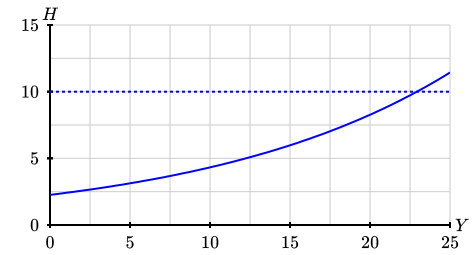
Remember Jocelyn? She was asked to analyze information on rising health care costs. In 2007 the United States spent $2.26 trillion on health care and costs were projected to increase at an average of 6.7% annually for the subsequent decade. For the variables
\begin{align*}
H \amp= \text{ health care costs (\$ trillions) } \sim \text{ dep} \\
Y \amp= \text{ time (years since 2007) } \sim \text{ indep}
\end{align*}
she found the exponential equation
\begin{equation*}
H = 2.26\ast 1.067^{Y}
\end{equation*}
In what year did health care costs first pass $3 trillion? We can use successive approximation to find the answer, starting with the values she found earlier.
which is already over $3 trillion. What about 2011? Use \(Y=4\) to check that \(H \approx \$2.93 \text{ trillion}\text{,}\) which is almost, but not quite there. Must be 2012 was the year. Sure enough when \(Y=5\) we get \(H \approx \$3.12 \text{ trillion}\text{.}\) That’s it. Health care costs first passed $3 trillion in 2012. Well, at least according to our equation. As usual, we summarize the numbers in a table.
After his first beer, Stephen’s blood alcohol content (BAC) was already 0.04 and as he continued to drink, his BAC level rose 45% per hour. The equation is
\begin{equation*}
S = 0.04 \ast 1.45^T
\end{equation*}
where \(S\) is Stephen’s BAC and \(T\) is the time, measured in hours. Let’s think about the evaluating steps in this equation.
SubsectionSolving an exponential equation symbolically
Successive approximation gives us the answer fairly quickly. But there is an even quicker way — solving the exponential equation using the Shoes and Socks Principle. Start with what we’re looking for, which is \(H= 3\text{.}\) Use the equation \(H=2.26\ast1.067^Y\) to get
Hmm. How do we find \(Y\) here? We saw how to use roots to solve power equations. In our lemonade example we had \(C^3 = 714.2857\ldots\text{.}\) We knew the exponent (3) and wanted to find the number being raised to that power (\(C\)). That’s when we took the cube root to get
That approach is not going to work here because the operation is backwards now - we know the number being raised to a power (1.067) and are on the hunt for the exponent (\(Y\)) instead.
Turns out there’s a different formula for solving for the exponent that uses logarithms (nickname: logs). More about logs in a minute, but first let’s write down the formula and practice working with it. The formula is
Quick aside about the name. Some formulas have well-known names. Not this one. We call it the “Log-Divides Formula” because it has logs and divides in it. Perhaps you already guessed that. Other math books do not have a name for this formula, although it is related to something called the “change of base formula”.
A small note here about parentheses. Some calculators give the first parenthesis for free when you type log but you have to type the closing parenthesis in yourself.
This answer of 4.37 means that costs are projected to exceed $3 trillion just over 4 years after 2007. That’s some time during 2011, or by 2012 for sure. Same answer as before.
After his first beer, Stephen’s blood alcohol content (BAC) was already 0.04 and as he continued to drink, his BAC level rose 45% per hour. The equation is
\begin{equation*}
S = 0.04 \ast 1.45^T
\end{equation*}
where \(S\) is Stephen’s BAC and \(T\) is the time, measured in hours.
How long until Stephen’s BAC is 0.08? (Over this number, it is illegal for Stephen to drive!) Let’s use the Shoes and Socks Principle to solve this equation symbolically.
Let’s do another example for practice. Suppose instead we want to know when health care costs would exceed $10 trillion instead. (By the way - wow!) That means \(H = 10\text{.}\) Using our equation \(H=2.26\ast1.067^Y\) we get
Now our equation fits the format \(g^Y=v\) for the Log-Divides Formula with new value \(v=4.424778761\ldots\) (and the growth factor is \(g=1.067\) still). So the answer is
Again that means 23 years after 2007, or 2007 + 23 = 2030. Health care costs are projected to exceed $10 trillion in the year 2030. Well, unless we do something about that. (Helps explain why government folks are often discussing how to contain health care costs.)
What do you see? In each case the logarithm is the number of zeros. For example, has 4 zeros and \(\log(10{,}000)=4\text{.}\) Another way to think of this connection is
\begin{equation*}
10{,}000 = 10^4 \text{ and } \log(10{,}000)=4\text{.}
\end{equation*}
In other words, the logarithm is picking off the power of 10.
Wait a minute. The Log-Divides formula helped us find the value of \(Y\) which was an exponent. And now we see that the log of a power of 10 is that exponent. So a logarithm is just an exponent. And logarithms help us find the exponent. Makes sense.
To see what’s happening we want to involve powers of 10. Scientific notation will do that for us. Let’s write these numbers in scientific notation and see what we learn. For example,
At a BAC of 0.08 it is illegal for Stephen to drive. When will that happen? Set up and solve an equation using the Log-Divides Formula. Answer to the nearest minute.
Hopefully Stephen will stop drinking before he reaches a BAC of 0.20. If not, at the rate he is drinking, when would that be? Set up and solve an equation. Answer to the nearest minute.
Chlorine concentrations below 1.5 ppm do not disinfect properly so more chlorine needs to be added. According to your graph, approximately when will that happen? Give a reasonable estimate.
Solve the equation to find when the chlorine concentration would fall below 0.1 ppm (essentially no chlorine) assuming no chlorine was added earlier. Show how to solve the equation to find the answer (and check it!).
Rent in the Riverside Neighborhood is expected to increase 7.2% each year.
Aside
Average rent for an apartment is currently $830 per month. Earlier we identified the variables as \(R\) for the monthly rent (in $) and \(T\) for time in years.
They have been in the house for 5 years now and due to a downturn in the housing market, their house is worth only $150,000. Are they underwater? That is, do they owe more than the house is worth?
The number of school children in the district from a single parent household has been on the rise.
Aside
In one district there were 1,290 children from single parent households in 2010 and that number was expected to increase about 3% per year. Earlier, we found the equation was
\begin{equation*}
C = 1{,}290\ast1.03^Y
\end{equation*}
where \(C\) is the number of children and \(Y\) is the years since 2010.
Use successive approximation to determine when there will be over 3,000 school children in the district from a single parent household. Display your work in a table. Round your answer to the nearest year.
Show how to solve the equation to calculate when there will be over 3,000 school children in the district from a single parent household. Show how you solve the equation.
Darcy likes to use temporary hair color in wild colors.
Aside
Good thing it washes out. Her best guess is that 8% of the color washes out each time she washes her hair. That means the percentage of color remaining, \(C\text{,}\) is a function of the number of times she washes her hair, \(W\text{,}\) according to the equation
By the time only 10% of the color remains you really can’t tell anymore if it was pink or orange or blue. So, she might as well switch to a new color then. How many washes before only 10% remains? Again, first solve. Then check.