Earlier in this book, we’ve encountered several stories where we want to make a choice between several different options, where each option has a different linear equation attached. In this section we’ll learn how to use our solving skills to quickly compare multiple options and make good decisions.
A local factory produces small locks for industrial use. The old machine has seen better days and Quia Xun, the manager, is shopping around for a new machine. She’s narrowed it down to two options. The first option is replace the old machine with a new model (Machine 1) for $3,200. The second is a larger machine (Machine 2) priced at $5,400. In each case, the price includes installation and the standard service contract. The reason she is considering the more expensive machine is Machine 2 runs at a cost of only $0.80 per lock, whereas the replacement Machine 1 runs at a cost of $1.25 per lock.
Before we do anything fancy with any of these numbers, let’s pause for a second and just think about the situation. Without doing any calculations, write a sentence or two explaining your thinking about each of the questions below.
Since Machine 1 is less expensive, Quia Xun knows it is the right choice if the factory only produces a small number of locks. But since Machine 2 costs less per lock to run, she knows it will pay off if the factory makes a large number of locks. She would like to understand the total expenditure better, particularly the number of locks at which it would be worthwhile to invest in the more expensive machine.
Since Quia Xun is interested in how the total expenditure, including both the purchase price and the running cost, depend on the number of locks produced, the variables are
\begin{align*}
L \amp= \text{ amount produced (locks) } \sim \text{ dep} \\
E \amp= \text{ total expenditure (\$) } \sim \text{ indep}
\end{align*}
She recognizes that total expenditure is a linear function that depends on the purchase price and the running cost for each machine. In each case, the starting amount (intercept) is the purchase price: $3,200 for Machine 1 and $5,400 for Machine 2. The slope (rate of change) is the constant running cost: $0.80 per lock for Machine 1 and $1.25 per lock for Machine 2. Using the template for a linear equation
Madison wants to buy a new car, either Car A: a hybrid priced at $26,100, or Car B: a high-efficiency gas car priced at $23,700. Annual fuel costs for Car A are currently $1,100 per year. For Car B annual fuel costs are currently $1,800 per year. The total cost of each car will depend on how many years she keeps it.
Write a linear equation for the total cost (including purchase price and fuel costs) of Car A as a function of how long she keeps it. Assume fuel costs are constant.
Write a linear equation for the total cost (including purchase price and fuel costs) of Car B as a function of how long she keeps it. Assume fuel costs are constant.
If the factory were only going to make only 2,000 locks, then Machine 2 would not be worth it. She calculates a few more examples to see what the cutoff would be.
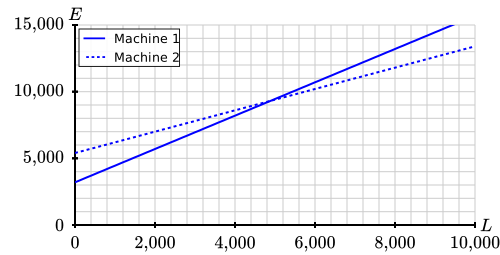
Quia Xun makes a quick graph to see what’s going on. On the graph, whichever line is lower corresonds to the lower total expenditure and whichever line is higher corresponds to the higher total expenditure. As suspected, for a smaller number of locks the line for Machine 1 is lower on the graph, so that’s the better deal. For a larger number of locks it switches and the line for Machine 2 is lower on the graph, since that’s the better deal instead. Where they switch corresponds to the point on the graph where the two lines cross, somewhere around 5,000 locks.
Madison wants to buy a new car, either Car A: a hybrid priced at $26,100, or Car B: a high-efficiency gas car priced at $23,700. Annual fuel costs for Car A are currently $1,100 per year. For Car B annual fuel costs are currently $1,800 per year. The total cost of each car will depend on how many years she keeps it.
Use successive approximation to approximate the payoff time, or the number of years for which the total costs of each car are equal. Figure out your answer accurate to the nearest half-year.
We could certainly keep doing successive approximation and get as close as we wanted to the “breakeven point” where Machine 2 becomes cheaper than Machine 1. Quia Xun thinks this is tedious, though. She decides to think a bit harder about the differences between the two machines.
There are two important differences between the two machines: their purchase prices and their cost per lock. First, Quia Xun decides to figure out the difference between the two purchase prices:
But Quia Xun is more interested in total expenditure ($) than running costs per lock. So, she writes:
\begin{equation*}
1.25\, \dfrac{\text{\$}}{\cancel{\text{lock}}} \ast L \cancel{\text{locks}}-
0.80\, \dfrac{\text{\$}}{\cancel{\text{lock}}} \ast L \cancel{\text{locks}} =
0.45\, \dfrac{\text{\$}}{\cancel{\text{lock}}} \ast L \cancel{\text{locks}}\text{.}
\end{equation*}
See the fancy unit work here? Simplifying, she finds out that when producing \(L\) locks, Machine 1 costs \(0.45L\) more dollars to run than Machine 2.
A couple of things to notice here. See how in both calculations she decided to do the larger minus the smaller? It doesn’t really matter, but Quia Xun likes working with positive numbers a bit better than working with negative numbers, and this is a way she can easily avoid them. Also, notice that she didn’t do
Madison wants to buy a new car, either Car A: a hybrid priced at $26,100, or Car B: a high-efficiency gas car priced at $23,700. Annual fuel costs for Car A are currently $1,100 per year. For Car B annual fuel costs are currently $1,800 per year. The total cost of each car will depend on how many years she keeps it.
Find the difference between the two fuel costs, including units. (Don’t forget “per year”!) Write a sentence explaining what your calculation means about the two cars.
Multiply by the number of years (which is a variable you named earlier!) to cancel out the “per year.” Write a sentence explaining what your calculation means about the two cars.
There is a way for Quia Xun to solve the problem symbolically; we refer to this process as solving the system. She wants to find the number of locks where
\begin{equation*}
E=E\text{.}
\end{equation*}
That sounds silly, so let’s be a bit more specific: she wants to find the number of locks where
\begin{equation*}
E \text{ (for Machine 1)} = E \text{ (for Machine 2)}\text{.}
\end{equation*}
Using her equations \(E =3{,}200 + 1.25L\) for Machine 1 and \(E =5{,}400 + 0.80L\) for Machine 2, she has
Thinking back to the differences that she computed earlier, Quia Xun subtracts \(0.80L\text{,}\) the smaller of the two dollar amounts for running the machine, from each side to get
What next? Now that she only has the variable \(L\) occurring in one place, it’s just like solving a linear equation like we’ve done before! The evaluating steps that are happening are, first multiply by 0.45, and then add 3,200. So all Quia Xun has to do is apply the Shoes and Socks Principle. First she subtracts 3,200 from both sides:
If they plan to produce 4,889 locks or more, Quia Xun should go ahead and buy the more expensive machine, Machine 2. Yeah, that’s what we guessed — just under 4,900 locks is the payoff.
Back to Madison’s car shopping: Madison wants to buy a new car, either Car A: a hybrid priced at $26,100, or Car B: a high-efficiency gas car priced at $23,700. Annual fuel costs for Car A are currently $1,100 per year. For Car B annual fuel costs are currently $1,800 per year. The total cost of each car will depend on how many years she keeps it.
Madison wants to buy a new car, either Car A: a hybrid priced at $26,100, or Car B: a high-efficiency gas car priced at $23,700. Annual fuel costs for Car A are currently $1,100 per year. For Car B annual fuel costs are currently $1,800 per year. The total cost of each car will depend on how many years she keeps it.
Write a linear equation for the total cost (including purchase price and fuel costs) of Car A as a function of how long she keeps it. Assume fuel costs are constant.
Write a linear equation for the total cost (including purchase price and fuel costs) of Car B as a function of how long she keeps it. Assume fuel costs are constant.
A mug of coffee costs $3.45 at Juan’s favorite cafe,
Aside
unless he buys their discount card for $10 in which case a mug costs $2.90. Or, he can buy a membership for $59.99 and then coffee is only $1/mug. If we let \(M\) represent the number of mugs of coffee he buys and \(T\) represent the total cost in dollars, then the equations are:
\begin{align*}
\textit{No card: } \qquad
T \amp= 3.45M\\
\textit{With card: } \qquad
T \amp= 10.00 + 2.90M\\
\textit{Membership: } \qquad
T \amp= 59.99 + 1.00 M
\end{align*}
Ahmed planted two shrubs in the backyard on May 1.
Aside
The viburnum was 16.9 inches tall and expected to grow 0.4 inches each week this summer. The weigela was 20.3 inches tall but only expected to grow 0.2 inches per week. If we let \(S\) represent the total height of the shrub in inches after \(T\) weeks, then the equations are:
\begin{align*}
\textbf{Viburnum:} \qquad
S \amp= 16.9 + 0.4T\\
\textbf{Weigela:} \qquad
S \amp= 20.3 + 0.2T
\end{align*}
The supply of flour is the amount of flour produced.
Aside
It depends on the price of flour. A high price encourages producers to make more flour. If the price is low, they tend to make less of it. The dependence of the supply of flour \(S\) (in loads) on the price \(P\) (in $/pound) is given by the equation
\begin{equation*}
\textbf{Supply: } S = 0.8P + 0.5
\end{equation*}
The demand of flour is the amount of flour consumers want to buy. It also depends on the price of flour. If flour sells for a high price, then consumers will buy less. If flour sells for a low price instead, then consumers will buy more. The dependence of the demand of flour \(D\) (in loads) on the price \(P\) (in $/pound) is given by the equation
\begin{equation*}
\textbf{Demand: } D = 1.5 - 0.4 P
\end{equation*}
When more of a product is produced than consumers want to buy, we have a surplus of the product. Solve an inequality to find the range of price values for which there will be a surplus of flour. Compare your answer to part (d).
When less of a product is produced than consumers want to buy, we have a shortage of the product. Solve an inequality to find the range of price values for which there will be a shortage of flour. Compare your answer to parts (d) and (e).
Just when Quia Xun thought she had things figured out, another possible option emerged. She can outsource her lock production to a different plant at the cost of $1.55 per lock. While that’s more expensive per lock, it avoids having to buy a machine at all. Recall her first two options were
Don’t ask why I know this, but it takes me 80 seconds per square foot to wash a floor using a rag. If I use a mop, it’s slightly quicker at 75 seconds per square foot, but another 3 minutes at the end to wring out the mop. (The rag just pops in the washing machine.)
What do you suggest for each room? (Note: find the area by multiplying the length times the width.) My bathroom floor is 5′\(\times\)5′. My kitchen floor is 8′\(\times\)10′. The laundry room is 10′\(\times\)14′.
Maria needed to replace the light bulb in the hallway. When she went to the home improvement store she was overwhelmed with the choices of light bulbs. One option is a compact fluorescent light (CFL) bulb. A CFL bulb costs $1. This fixture will cost $0.95 per month to run with a CFL bulb. A different option Maria is considering is a light-emitting diode (LED) instead of a bulb. A LED costs $24 but reduces the cost for the fixture to $0.60 per month.
The community center offers exercise classes on a pay-as-you-go basis. It normally costs $20 to register and then $15 per exercise class. Alternatively, you can pay $150 to become a member, and then $10 per exercise class. If we let \(E\) represent the number of exercise classes I attend and \(T\) represent the total cost in dollars, then the equations are:
\begin{align*}
\textbf{Pay as you go:} \qquad
T \amp= 20 + 15E\\
\textbf{Member} \qquad
T \amp= 150 + 10E
\end{align*}
A solar heating system costs approximately $30,000 to install and $150 per year to run.
Aside
By comparison, a gas heating system costs approximately $12,000 to install and $700 per year to run. Earlier we wrote equations showing how the total cost $\(T\) depends on the time, \(Y\) years.
\begin{align*}
\textbf{Solar:} \qquad
T \amp= 30{,}000 + 150Y\\
\textbf{Gas:} \qquad
T \amp= 12{,}000 + 700Y
\end{align*}
How does the payback time change if the state offers a $7,000 rebate? That means, in effect, that the solar system costs $7,000 less to install. Write a new equation for the solar heating system. Then set up and solve the new system.
How high a rebate would the state have to offer to ensure a payback time of 15 years? Hint: compare the costs of gas and solar heating systems at 15 years.