A diver bounces on a 3-meter springboard. Up she goes. A somersault, a twist, then whoosh, into the water. This table shows the diver’s height as a function of time:
\begin{align*}
H \amp= \text{ diver's height (meters) } \sim \text{ dep} \\
T \amp= \text{ time (seconds) } \sim \text{ indep}
\end{align*}
In case you’re wondering, 3 meters is nearly 10 feet up and the highest height listed, 4.48 meters, is close to 15 feet above the water. More on how we figured those numbers out in the next section, but thought you might like to know.
How fast is she moving? The diver starts at 3 meters, which is the height of the springboard, and 0.2 seconds later she’s up to 3.88 meters. That means during the first 0.2 seconds, the diver went up
You’re thinking about buying a larger cake so you can invite more people to your party. How much more expensive is it to buy a cake for 15 people than it is to buy a cake for 8 people?
Back to the diver: What about during the next 0.2 seconds? Does she move faster, slower, or the same? During this time, her height changed from 3.88 meters to 4.38 meters. In these 0.2 seconds she rose
See how we put parentheses around both the top and bottom of the fraction? We needed them to force the calculator to do the subtractions first and division second. The usual order of operations would do it the other way around: multiplication and division before addition and subtraction. (If you need a reminder, the full list of the order of operations is discussed in Section 0.4.) Because the top and bottom of the fraction each have meaning in the story, we continue to calculate them separately, but feel free to do the whole calculation at once if you prefer.
In our story, we calculated two different speeds of the diver at two different times. Even though we got different numbers, we used the same formula to figure out her speed. In general, the result of this formula is called the rate of change of the function over that interval of values.
Notice how the change in dependent variable (height, in meters) is on top of the fraction and the change in independent variable (time, in seconds) is on the bottom. That makes sense in our example because speed is measured in meters/second. The units can help you keep that straight.
You’re thinking about buying an even larger cake so you can invite even more people to your party. How much more expensive is it to buy a cake for 40 people than it is to buy a cake for 15 people?
What does a negative speed mean? During this time interval her height drops. She’s headed down towards the water. Her speed is 1.4 meters/sec downward. The negative tells us her height is falling. What goes up, must come down. Sure enough.
You may notice that the sign − used for subtraction and - used for negation look very similar. On the calculator these are two different keys. The subtraction key reads just -. The negation key often reads (-) and is done before the number. This does not mean you type in parentheses, just hit the key that is labeled (-) already. (If your calculator does not have a key labeled (-), look for a key labeled +/- instead. That is not three keys, just one labeled +/-. To emphasize that it is one key, we just write ±. Often that key needs to follow the number, so enter
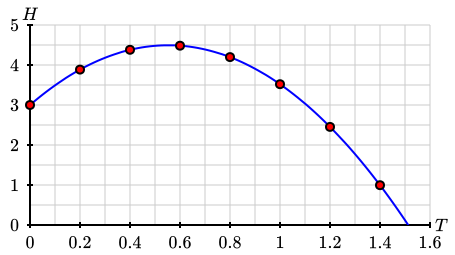
Let’s graph our diver’s heights. Notice that time is on the horizontal axis because it’s the independent variable and height is on the vertical axis because it’s our dependent variable: height depends on time.
As usual we drew in a smooth curve connecting the points, which illustrates our best guesses for the points we don’t know and we continued the graph until the height was zero (when the diver hits the water). The values from our table are indicated with big points to help explain what’s going on.
There is a way to see the rate of change from the graph. In the case of our diver, the graph looks like a hill. The curve goes uphill at first. Between the first two points it is rather steep and the rate of change is 4.4 meters/sec there. The next segment is less steep and that’s where the rate of change is less, down to 2.5 meters/sec. The third line segment is almost flat and that’s where the rate of change is only 0.5 meters/sec. Aha. The rate of change corresponds to how steep the curve is.
We notice the same connection between the rate of change and steepness of the curve for the downhill portion, only this time all the rates of change are negative. The first downhill segment is not very steep and the rate of change is just -1.4 meters/sec there. The next downhill segment has rate of change -3.4 meters/sec and the graph is steeper. The next two downhill segments are steeper and steeper yet and this time with rates of change -5.35 and -7.25 meters/sec.
A little more vocabulary here. For the uphill portion of the diver’s height graph, from 0 to just before 0.6 seconds, the rate of change is positive. The function is increasing there: as the independent variable gets larger, so does the dependent variable. After about 0.6 seconds, the graph is downhill and the rate of change is negative. The function is decreasing there: as the independent variable gets larger, the dependent variable gets smaller.
When does the diver’s height stop increasing and start decreasing? When she’s at the highest height, some time just before 0.6 seconds into her dive. Before then her rate of change is positive. After that time her rate of change is negative. So, at the highest height her rate of change is probably equal to zero. Does that make sense? Think about watching a diver on film in very slow motion. Up, up she goes, then almost a pause at the top, and then down, down, into the water. At the top of her dive it’s as if she stands still for an instant. That would correspond to zero speed.
Rashad measured his heart rate several times after football practice. Right after practice his heart rate was 178 beats per minute. Two minutes later, it had dropped to 153 beats per minute, and by ten minutes after practice it was down to 120 beats per minute.
Rashad does not like hitting the showers until his heart rate is close to normal, or at least below 100. He usually waits 15 minutes after practice. Do you think that’s long enough? Explain.
Approximately how fast is the diver moving as she enters the water? Use that her height at 1.4 seconds is 1 foot above water (given earlier), but also her height at 1.5 seconds is just 0.12 feet above water.
Calculate the rate of change in electricity as a function of wind speeds from 0 to 10 mph. Sketch in the line segment connecting those two points on the graph.
During which period of time was the Earth’s population increasing the fastest? Calculate the rates of change for each time period to decide. (Or, explain some other way of deciding.)
The more they make, the less it costs for each one, but only up to a certain point. For example, if they produce 10 backpacks, it would cost $39 each. For 40 backpacks, they would cost $18 each. By 70 backpacks, the unit cost is down to $15 each. But at 100 backpacks, the unit cost is back up to $30 each.
The public beach near Paloma’s house has lost depth (measured from the dunes to the high water mark) due to erosion since they started keeping records 60 years ago.
Aside
The table shows a few values. Here \(D\) is the depth of the beach in feet, and \(Y\) is the year, measured since 60 years ago.