So far we’ve seen examples of linear equations and exponential equations. There are lots of other kinds of equations that we might use! Whatever kind of equation we have, and however we figured it out, we can always use the equation to figure out the value of the dependent variable that’s associated with a particular value of the independent variable. We might call this process “plugging in,” but its official name is evaluating.
When we are evaluating a function, this means we know a value of the independent variable (an input) and we want to figure out the corresponding value of the dependent variable (the output).
Just as important as evaluating a function is thinking about what our result means. Not only is this a good way to catch any calculator mistakes we might have made, but also it’s how algebra helps us make good decisions in the real world.
Write a sentence explaining what your result means. To help you get started, here’s a template: “Our equation predicts that in years after 2007, health care costs were $ trillion.”
The Cadillac Escalade is a cross between a sports utility vehicle (SUV) and luxury car. Either way, it’s a big car. And it takes awhile to stop. One study showed that the 2010 Escalade traveling at 60 miles per hour takes about 144 feet to come to a complete stop from when the driver first hits the brakes. In fact, the braking distance of any car depends on how fast it is going. If someone is driving slowly they can stop in shorter distance than if they are driving fast. Which is why you should drive slowly on residential streets.
You may be a little surprised to see the variable \(S\) squared (raised to the 2nd power) or wonder what the number 0.04 means. This equation is not something we can figure out because it relies both on the data and knowledge of the physics involved. But, we can still work with this equation to find the braking distances at any speed. (If you must know, this equation is only approximate since things like tire and road conditions are a factor, but for what we want it is good enough.)
Although in the last couple of sections we were able to find equations by generalizing examples, there are actually many different mathematical and statistical techniques for finding equations. A scientist might use lab experiments and some theory to figure it out. An economist might recognize that the equation fits a certain template because of the underlying economics. A store manager might know from years of experience that a certain equation works well to predict sales. It can be comforting to know where an equation comes from but whether we find an equation for ourselves or get it from an expert, we can use it to answer our questions and make predictions.
Now that we have an equation we should check the reported stopping distance at 60 mph. We have \(S=60\) so we substitute 60 in place of \(S\) in the equation to get
Quick reminder about terminology. When we know the independent variable, like \(S=60\) and we substitute into the equation to find the dependent variable, like \(B\text{,}\) we say we evaluate the function \(B\) at \(S=60\text{.}\) You might have noticed that the 60 was underlined in the calculation above. In this book we underline the value of the independent variable when we are evaluating. That way it’s easier to see which numbers come from the equation and which number we’re plugging in. Feel free to do the same. Or not.
Let’s use our equation to calculate the braking distance for a Cadillac Escalade traveling 30, 50, 70 or 90 miles per hour. For 30 miles per hour, we have \(S=30\text{.}\) So, we evaluate at \(S=30\) to get
At 30 mph, it takes the Cadillac Escalade 36 feet to stop. As we expected, it doesn’t take nearly as far to stop as it did at 60 mph. For the other speeds we do the same thing: evaluate at the appropriate value of \(S\text{.}\) When \(S=50\) mph we get
Dontrell and Kim borrowed money to buy a house on a 30-year mortgage. After \(T\) months of making payments, Dontrell and Kim will still owe $\(D\) where
My neighbor Jeff happens to drive a 2010 Cadillac Escalade. The other day he almost was in an accident on the highway. Luckily no one was hurt, but he had to slam on the brakes to stop. The police report mentioned they believe it took his car 183 feet to stop. Jeff says he was not driving over the posted speed limit of 65 mph. Should we believe him?
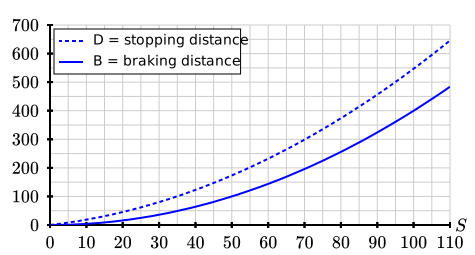
We can see from the table that braking distance of 183 feet falls in between the 144 and 196 on our table which leads us to believe that Jeff was traveling faster than 60 mph and slower than 70 mph. We can figure out if Jeff were driving at 65 mph, then his braking distance would have been
But wait a minute. The braking distance is just the time it takes from when the driver’s foot hits the brake until the car stops. That distance doesn’t take into account the driver’s reaction time — how long between when the driver thinks to stop and when the driver’s foot actually hits the brake. We have a new dependent variable:
\begin{align*}
D \amp= \text{ total stopping distance (feet) } \sim \text{ dep} \\
S \amp= \text{ speed (mph) } \sim \text{ indep}
\end{align*}
How can we include this reaction time into an equation? Suppose it takes 1 second to react. We would like to know how many feet that adds to the equation. This is something we can figure out. We know the speed and the time, so multiply them to get the distance, right? One small snag: the speed is in mph (miles per hour). We need to convert units.
What all this means is that we should add 1.47 feet for every mph of speed. So \(S\) mph adds \(1.47\ast S\) feet to the stopping distance. Long story short, our new equation is
Something interesting about this equation. The independent variable \(S\) appears twice; first for the braking distance and again because of the reaction time. When we evaluate the function we need to plug in the value of \(S\) in two places. Check it out. When \(S=30\) mph we have
These numbers make us rethink Jeff’s assertion. Given that he stopped in 183 feet, which is much less than the 232 feet it takes to stop at 60 mph, it looks like Jeff was driving less than 60 mph. To be sure, calculate that at 65 mph, it would have taken Jeff
The distance of 183 feet falls just above the unlabeled gridline for 175 and below the gridline for 200. Looking at the corresponding point on the braking distance curve, it looks like it falls around 67 mph, but looking at the corresponding point on the stopping distance curve, it looks like just over 50 mph.
“Rose gold” is a mix of gold and copper. We start with 2 grams of an alloy that is equal parts gold and copper and add \(A\) grams of pure gold to lighten the color. The percentage of gold in the resulting rose gold alloy, \(R\) is given by
\begin{equation*}
R = 100\left(\frac{1+A}{2+A}\right)
\end{equation*}
For example, if we add 0.8 grams of pure gold, then \(A=0.8\) and so the percentage is
Before we leave, let’s learn a little vocabulary about a few more kinds of equations. Our first equation
\begin{equation*}
B = 0.04 \ast S^2
\end{equation*}
is a power equation because the independent variable is being raised to a power, \(n=2\text{,}\) and then scaled by a proportionality constant, \(k=0.04\text{.}\) Any power equation fits this template.
is a polynomial equation because it includes both a linear term and powers. The exercises introduce more polynomial equations. Polynomials can have any powers, but in this equation the highest power happens to be 2. This type of polynomial equation has a special name. It is a quadratic equation. Any quadratic equation fits this template.
We start with 2 grams of an alloy that is equal parts gold and copper and add \(A\) grams of pure gold to lighten the color. The percentage of gold in the resulting rose gold alloy, \(R\) is given by
\begin{equation*}
R = 100\left(\frac{1+A}{2+A}\right)
\end{equation*}
For example, if we add 0.8 grams of pure gold, then \(A=0.8\) and so the percentage is
Monty hopes to grow orchids but they are fragile plants.
Aside
He will consider his greenhouse a success if at least nine of the ten orchids survive. Assuming the orchids each survive at rate \(S\text{,}\) the probability his greenhouse is a success, \(P\text{,}\) is given by
Valerie plans to do a charity walk to raise money for breast cancer research, in honor of her aunt. Valerie’s friends have pledged a total of $93 per mile.
She might have to stop sooner, however. Name variables and write an equation showing how the money Valerie raises is a function of how far she is able to walk.
The 2002 Chevrolet Tahoe 4WD will take about 158.1 feet to stop when traveling at 60 mph in normal highway conditions.
Aside
Let \(S\) be the speed at which the vehicle is traveling, in miles per hour (mph), and \(D\) the distance it takes to stop, in feet. This information together with a little physics gives the equation
\begin{equation*}
D = 0.0439S^2 + 1.47S
\end{equation*}
In driver’s training classes they teach the “two-second rule” for safety: you should follow no closer than two seconds behind the car in front of you. If you are traveling 80 miles per hour, how many feet can you travel in two seconds? Hint: convert to feet per second, then multiply by two seconds.
Compare your results from parts (a) and (b) to decide if the “two-second rule” is adequate for safety at 80 miles per hour. That is, if you are following two seconds behind the car in front of you and calamity strikes that car, will you be able to stop before hitting it?
Mom always said to sit close to the lamp when I was reading.
Aside
The intensity of light \(L\text{,}\) measured in percentage (%) that you see from a lamp depends on your distance from the lamp, \(F\) feet as described by the formula
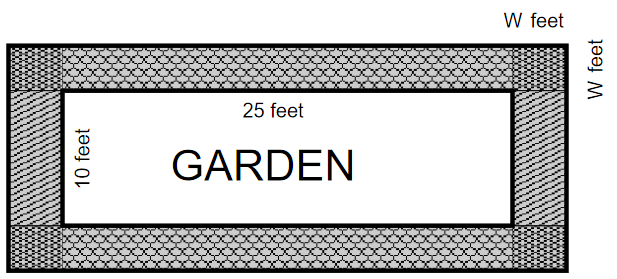
What was once an abandoned lot down the block is now a thriving 10′\(\times\)25′ vegetable and berry garden for the neighborhood. (Remember ′ stands for “feet,” so the garden is 10 feet wide and 25 feet long.) One neighbor volunteered to donate gravel to make a path around the garden. The path will be 3 inches deep and the same width all around.
Suppose for the moment that the path will be 4 feet wide. Calculate the area of the path. Here’s one way to do it: first, find the area of the outer rectangle, then subtract the area of the garden itself.
Hint: the length of that outer rectangle includes the 25 feet of garden plus the width of the path on each side. Same for the width of that outer rectangle.
Actually, they aren’t sure how wide the path should be and how much gravel they can get. Let’s write \(W\) = width of path (feet) and \(G\) = amount of gravel (cubic feet). It turns out that
\begin{equation*}
G = W^2 + 17.5W
\end{equation*}
Check that when you evaluate at \(W=4\) you get the same answer as in (c).
One measure of the diversity of our news source is the count of the number of different daily newspapers in circulation. A reasonable equation estimating this count over the past century is
\begin{equation*}
N = -0.0021T^3+0.34T^2-20T+ 2{,}226
\end{equation*}
where \(N\) is the number of daily newspapers in circulation in the United States \(T\) years after 1900.
He is paid a salary of $780 per week but his hours vary week-to-week. Even though Wynter is not paid by the hour, he can figure out what his hourly wage would be depending on the number of hours he works. For example, in a week where Wynter works 40 hours, he’s earning the equivalent of $19.50/hr because