You’re expecting family for dinner in a few hours and, wouldn’t you know it, but your kitchen sink is clogged. The bottle of drain opener didn’t clear it out. Your brother-in-law has offered to help, but last time he tried he only made it worse. If you decide to call the plumber, what will it cost?
Plumbers usually charge a trip charge — which is a set amount to cover their travel time and their professional expertise — and then an hourly rate to cover the amount of time they spend working on your sink. The longer it takes them to repair your sink, the more your final bill will be.
You looked up a local plumber and asked about his rates. The plumber will charge you $100 just to come to your house. In addition, there will be a charge of $75 per hour for the service.
For example, if the plumber takes one hour, then he’ll charge you $100 for showing up and $75 for the one hour of work. So, the total plumber’s bill will be
Let’s hope it wouldn’t take the plumber as long as three hours, but if it did, we can do a similar calculation. Add the trip charge of $100 to the additional charge of $75 for each of the three hours. The plumber’s bill would be
What would happen if the plumber was taking so long to get to your house that before he got there you dumped another bottle of drain opener in the sink and that did the trick? But before you could call and cancel the plumber, wouldn’t you know it, there he was. What do you owe him for that 0 hours of work? Probably $100. Unless your plumber says to “forget it.”
A truck hauling bags of grass seed pulls into a weigh station along the highway. Trucks are weighed to determine the amount of highway tax. This particular truck weighs 3,900 pounds when it is empty. Each bag of grass seed it carries weighs 4.2 pounds. For example, a truck carrying 1,000 bags of grass seed weighs
Each time we knew how long the plumber spent and calculated the plumber’s bill \(P\) by starting with the trip charge of $100 and adding in $75 times the number of hours. For example, for 3 hours we calculated
We have a name for the number of hours in general; it is \(T\text{.}\) So for \(T\) hours, we would calculate
\begin{equation*}
\$100 + T \text{ hours} \ast \frac{\$75}{\text{hour}}=P
\end{equation*}
See how we just put the \(P\) in for $325 and \(T\) where the 3 hours was? We’re just generalizing from our example. Drop the units and we have our equation. If the plumber works for \(T\) hours, then the cost is $\(P\) where
\begin{equation*}
P = 100 + T \ast 75
\end{equation*}
We started the equation “\(P=\)” because it is a convention to begin equations with the dependent variable, when possible.
An equation is a formula that shows how the value of the dependent variable (like \(P\)) depends on the value of the independent variable (like \(T\)). We usually write an equation in the form
There is a mathematical convention that we write numbers before letters in an equation. So, instead of \(T \ast 75\) we should write \(75 \ast T\text{.}\) There’s a conventional shorthand for this product: when a number and letter are next to each other, it means that they are multiplied. So, instead of \(75 * T\) we should write \(75T\text{.}\) Thus our equation is normally written as
\begin{equation*}
P = 100 + 75T.
\end{equation*}
You’ll have to remember the hidden multiplication when you’re calculating.
Let’s practice writing an equation for the weight of the truck hauling bags of grass seed. Remember, this particular truck weighs 3,900 pounds when it is empty, and each bag of grass seed weighs 4.2 pounds.
We decided that the independent variable is the number of bags of grass seed the truck is carrying. What letter did you choose for this variable, and which number is that in the calculation above?
We decided that the dependent variable is the total weight of the loaded truck. What letter did you choose for this variable, and which number is that in the calculation above?
Write down an equation by replacing the numbers in the calculation above by the letters you chose. Remember that it is a convention to begin equations with the dependent variable.
Suppose the plumber shows up at your house and repaired the sink in 25 minutes. Whew! No sooner do you pay your bill than your first dinner guest arrives. How much do you owe the plumber? Notice that
It was important that we rounded off our final answer because we had rounded off to get 0.4166 along the way. We could have done the entire calculation at once (avoiding the round off error) as
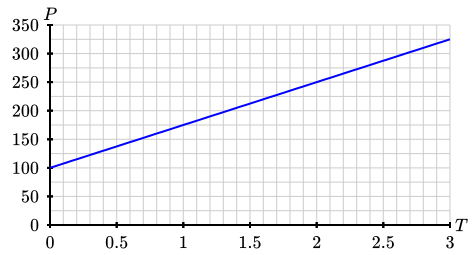
Why are these kinds of functions called “linear”, anyway? Good question. Turns out that any time we have a linear function, if we plot the points from the table of values in a graph, we see that the points lie on a straight line. In Chapter 1 we highlighted the points from our table on the graph. It is more common to just show the smooth curve or line.
Why is the graph a straight line? Remember that the rate of change tells us how steep the graph is. For example, let’s find the rate of change between 1 hour and 2 hours.
Sure! We knew that. The plumber charges an extra $75 for each extra hour he works. The rate of change is precisely $75/hour, no matter where we calculate it. Since the rate of change is constant, the graph is the same steepness everywhere. So, the graph is a straight line, and the function is linear. Another way to say this is a function with constant rate of change is linear. The plumber’s total charge is a linear function of time.
Choose any two points from the table of values above and calculate the rate of change between them; your answer should be 4.2. What are the units on your answer, and why does this number make sense in the story?
Just like we generalized from our specific calculations for the plumber’s cost to write down an equation that would work for any amount of time, we can generalize our work in this entire story to notice a pattern that any linear equation would follow. In this book we call a pattern like this a template.
Notice our two variables are in our equation and there are two constants. Each constant has its own meaning. The first constant is 100 and it is measured in dollars. It is the trip charge, the set amount we would owe the plumber even if he does 0 hours work. In our standard form we refer to this quantity as the starting value (or start for short), but its official name is intercept. On the graph it’s where the line crosses the vertical axis. Think of a football player (running along the vertical axis) intercepting a pass (coming in the line). We can find the intercept from our equation by plugging in \(T = 0\) so that
The second constant is 75, and though it’s tempting to say it is measured in dollars, it is really measured in dollars per hour (\(\frac{\text{\$}}{\text{hour}}\)). This number is the rate of change, and in the context of linear equations it gets its own name too: it’s called the slope. Since the rate of change measures the steepness of any curve or line, the word “slope”, like mountain slope, makes sense. In our plumber example the intercept was $100 and the slope was $75/hour.
It’s always useful to explain in everyday words what the constants in an equation mean in the story. The two constants in the story about the truck hauling bags of grass seed are 3,900 and 4.2.
A truck hauling bags of grass seed pulls into a weigh station along the highway.
Aside
Trucks are weighed to determine the amount of highway tax. This particular truck weighs 3,900 pounds when it is empty. Each bag of grass seed it carries weighs 4.2 pounds. For example, a truck carrying 1,000 bags of grass seed weighs
The bags of grass seed are piled on wood pallets (sturdy platforms) to make them more stable for moving. How much does the truck weigh if it is carrying 12 pallets, where each pallet weighs 15 pounds and holds 96 bags of grass seed?
The water in the local reservoir was 47 feet deep,
Aside
but there has been so little rain that the water level has dropped 18 inches a week over the past few months. Officials are worried that if dry conditions continue, the reservoir will not have enough water to supply the town.
I was short on cash so I got a line of credit (short term loan) on my bank account, of which I spent $2,189.57. That means my account balance is \(-\$2{,}189.57\text{.}\) I will pay back the interest plus an extra $250 each month. When the loan is paid off, I plan to continue to deposit $250 per month to start saving.
How would the equation change if the cafe offers a new annual membership card that costs $59.99 that entitles Juan to buy coffee for only $1 per mug all year?
Plumbers are really expensive, so I’m comparing their rates.
Aside
Write an equation for each possibility, using the same variables as our example: \(T\) for the time the plumber takes (in hours) and \(P\) for the plumber’s total charge (in dollars).
Not to be outdone, Luigi offers to unclog any drain for $150, no matter how long it takes. (“Wake up, Luigi! The only time plumbers sleep on the job is when we’re working by the hour,” says Mario.)
The local burger restaurant had a promotion this summer.
Aside
Typically a bacon double cheeseburger costs $7.16. They reduced the price by 2¢ for each degree in the daily high temperature. For example, if the high temperature was 80°F, they would decrease the price by \(0.02 \times 80 = \$1.60\text{,}\) so the double cheeseburger would cost \(7.16-1.60=\$5.56\text{.}\) Mmmm.
At this rate of decline, in what year will we have only \(\tfrac12\) million beds? First estimate the answer from your table. Then figure it out, to the nearest year.
The stretch of interstate highway through downtown averages 1,450 cars per hour during the morning rush hour.
Aside
The economy is improving (finally), but with that the county manager predicts traffic levels will increase around 130 more cars per hour each week for the next couple of weeks.
Significant slowdowns are expected if traffic levels exceed 2,000 cars per hour. When do they expect that will happen? Estimate your answer from your table. (Or, figure it out.)