Remember that there are two constants in the Linear Equation Template, one called “start” (or “intercept”) and the other called “slope” or, if we are feeling fancy, “rate of change.” In this section we’ll think more about slopes, how to find them, and what they mean.
Refresh your memory about identifying and explaining slopes by thinking about these stories. For each story below, say what number the slope is, identify the units of the slope (hint: it should involve “per”!), and explain what it means in the context of the story.
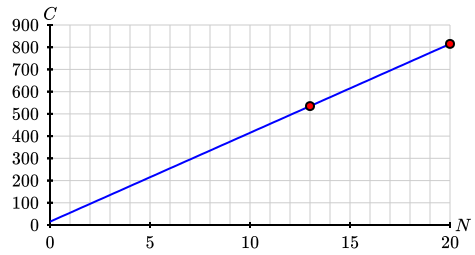
Last week our supplier delivered 13 cases of paper for the office and charged us $534.87. This week, they delivered 20 cases of paper for $814.80. We assume that their charge includes a fixed delivery fee and per case cost, so the dependence must be linear. We would like to understand their pricing scheme better by writing the equation.
What to do? We can name the variables and put the information we are given into a table. That’s a start. The variables must be
\begin{align*}
C \amp= \text{ total charge (\$) } \sim \text{ dep} \\
N \amp= \text{ number of cases delivered (cases) } \sim \text{ indep}
\end{align*}
Let’s see. The fixed delivery fee that we don’t know is the intercept. The per case cost that we also don’t know is the slope. To write the linear equation we need to know both.
For his Oscars party, Harland had 70 chicken wings delivered for $51.25. For his Super Bowl bash, Harland had 125 chicken wings delivered for $83.70. In each case, the total cost includes the cost per wing and the fixed delivery charge.
You can also check that the graph goes through the original two points we were given. The intercept is $15, but because of the scale it shows up as barely above $0 on our graph.
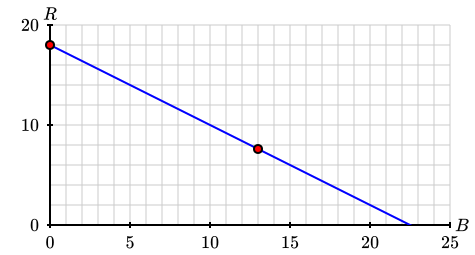
The supplier also picks up recyclable paper and boxes. They normally charge $18 per pickup, but under a new reuse incentive program, they discount a little for each box that’s in good enough condition to use again. This week’s recycling charge was only $7.60 because we returned the previous 13 boxes all in good shape.
Now we’re interested in how the recycling charge depends on the number of boxes in good condition that we return. The new variables are
\begin{align*}
R \amp= \text{ recycling charge (\$) } \sim \text{ dep} \\
B \amp= \text{ number of boxes returned (boxes) } \sim \text{ indep}
\end{align*}
Since there is a fixed discount per box, we again have a linear function. We know the intercept is the normal recycling fee of $18. We need to find the slope.
It might look funny to get a negative, but it’s to be expected. They are subtracting for each good box returned. The discount is 80¢ per box and so the equation is
\begin{equation*}
R = 18 - 0.8B\text{.}
\end{equation*}
What’s the most boxes you could get credit for? Probably the most they discount is the full $18, which would mean that \(R=0\text{.}\) That means we want to solve \(18 -0.8B = 0\text{.}\) Check that we get \(B = 22.5 \text{ boxes}\text{,}\) which means that 22 boxes would be almost $0 and for 23 boxes, they should pick up for free. We can check that 22 boxes gives
\begin{equation*}
R = 18-0.8\ast22=18-0.8 \times \underline{22} = \$0.40
\end{equation*}
The local ski resort is trying to set the price for season passes. They know from past experience that they will sell around 14,000 passes if the season ticket price is $380. If the price is $400, they will sell fewer, perhaps only 11,000 passes. You can assume this decrease in demand is linear.
For his Oscars party, Harland had 70 chicken wings delivered for $51.25. For his Super Bowl bash, Harland had 125 chicken wings delivered for $83.70. In each case, the total cost includes the cost per wing and the fixed delivery charge.
Jana is making belts out of leather strips and a metal clasp. A short belt (as shown) is 24.5 inches long and includes 7 leather strips. A long belt (not shown) is 37.3 inches long and includes 11 leather strips. Each belt includes one metal clasp that is part of the total length. All belts use the same length clasp.
The local ski resort is trying to set the price for season passes. They know from past experience that they will sell around 14,000 passes if the season ticket price is $380. If the price is $400, they will sell fewer, perhaps only 11,000 passes. You can assume this decrease in demand is linear.
The ski resort can compute the revenue (total amount of money they take in) by multiplying the ticket price times the number of tickets sold. Calculate the revenue when ticket prices are $355, $380, and $400.
Boy, am I out of shape. Right now I can only press about 15 pounds. (Press means lift weight off my chest. Literally.) My trainer says I should be able to press 50 pounds by the end of 10 weeks of serious lifting. I plan to increase the weight I press by a fixed amount each week.
I just saw an advertisement for the same paper we use at the office for only $4.25 per ream at a supply store. (Ream? Yes. That’s 500 sheets of paper, usually wrapped in paper.) Is that a good deal?
I’m not sure I want to go get a case of paper myself because a case of paper is pretty heavy to lift. Paper is sold by the weight. Thick, heavier paper is considered fancier than lighter paper. The office uses a multipurpose paper called “92” meaning it weighs 92 grams per square meter which comes out to around 5 grams per sheet. How much does a case weigh? Use \(1 \text{ kilogram} \approx 2.2 \text{ pounds}\text{.}\)
But, at the office we pay a delivery charge. Compare the cost of having just one case delivered versus me buying one case at the store. Recall that the office pays $15 delivery fee and $39.99 per case.
Write a new equation for paper cost assuming I pick it up at the store. Use \(N\) for the number of cases of paper and \(C\) is the total cost, in dollars. Hint: this equation is a direct proportionality.
Compare total cost if we get 4 cases either delivered or from the store. Repeat for 13 cases. Recall that the equation for delivered paper is \(C=15+39.99N\text{.}\)
If this trend continues, when will the amount of garbage generated exceed 300 million tons? Show how to set up and solve an inequality to find the answer. Be sure to state the actual year.
A 2010 report listed the amount of garbage at 249 million tons. Compare this information to your previous answer. What are some possible explanations for why this amount was less than expected (and actually decreased from 2006)?
Now that he is retired, Elmer gets a pension check from the Railroad Company each month. There’s a set amount he gets each month but the company deducts a fixed percentage of whatever outside income he earns. Elmer works part-time at the local hardware store. In February he earned $444.10 at the hardware store and his pension check that month was $886.23. In March he worked much less, earning only $179.30 at the hardware store; his pension check that month was $912.71.
What percentage of his income from the hardware store is deducted from his pension check? Calculate the fraction of a dollar deducted for each dollar earned. Convert your answer to percent.
Write an equation showing how Elmer’s pension check is affected by his income from the hardware store. Use \(H\) for his income from the hardware store and \(P\) for his pension check, both in dollars.
Elmer would like to earn enough at the hardware store to make at least $1,200 total per month. Using \(T\) for the total Elmer earns in a month (in dollars), write an equation for \(T\) as a function of \(H\text{.}\)Hint: start with \(T=H+P\text{,}\) then use your equation for \(P\) from part (c) to write everything with \(H\) instead.
If Elmer earns $8.15 per hour, how many hours does he need to work at the hardware store to make at least $1,200 total per month, accounting for his income from the hardware store and his pension check?
If you rent a truck and drive it 10 miles, how much do you think it will cost? As part of your work, name the variables and write a linear equation relating them.
Buoy instruments in the oceans report changes in the sea level.
Aside
In 2005 the sea level (averaged across all the oceans) was 51.7 millimeters above the historical sea level. In 2012 the sea level was 73.4 millimeters above the historical sea level. You can assume the increase is linear.