So far, we have learned to solve linear equations (and inequalities), which are the simplest kinds of equations because they only involve adding, subtracting, multiplying, and dividing. We know what the opposite is of each of those operations, so we can follow the Order of Operations to unravel them.
For each equation below, list the steps that you would do when evaluating, and then list the opposite steps in the opposite order that you would do when solving.
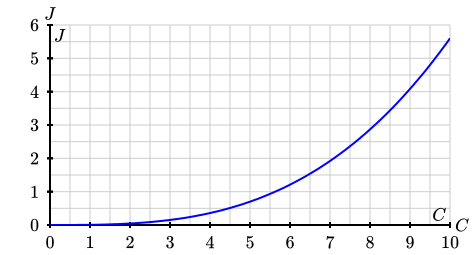
There’s an old saying: “when life gives you lemons, make lemonade.” But how many lemons do you need? It turns out a reasonable equation describing the juice from a single lemon is given by
Recipes for lemonade vary widely, but for my recipe calls for 4 tablespoons of lemon juice for each 12 ounce glass. The rest is a syrup made of hot water and sugar, mulled with a sweet herb like basil or mint, then finished with ice and cold water. Yum.
So, how large a lemon would yield 4 tablespoons of juice? Let’s try to guess the answer using successive approximation. For example, a small lemon 7 inches in circumference would yield
The weight of a wood cube is a function of the length of the sides. A cube with sides each \(E\) inches long has weight \(W\) ounces according to the equation
\begin{equation*}
W = 0.76\, E^3.
\end{equation*}
Let’s think about the evaluating steps in this equation.
\begin{equation*}
\text{dep} = k \ast \text{indep}^{n}
\end{equation*}
with power \(n=3\) and proportionality constant \(k=0.0056\text{.}\) Turns out we can solve any power equation symbolically, using the Shoes and Socks Principle.
We have found \(C^3\text{.}\) How can we “undo” the \(\wedge 3\) to find \(C\text{?}\) The answer: take the cube root of each side. (More about roots at the end of this section.) That means
The weight of a wood cube is a function of the length of the sides. A cube with sides each \(E\) inches long has weight \(W\) ounces according to the equation
Now, what goes better with lemonade than lemon cheesecake? For that we need lemon zest. Zest is what you get when you grate the lemon peel in long skinny strips. As with juice, the amount of lemon zest depends on the size of the lemon. Our variables are
\begin{align*}
Z \amp= \text{ amount of lemon zest (tablespoons) } \sim \text{ dep} \\
C \amp= \text{ circumference (inches) } \sim \text{ indep}
\end{align*}
My lemon cheesecake recipe calls for \(1 \tfrac12\) tablespoons of zest. There are various sized lemons at the store. How large a lemon should I buy? A small lemon of circumference 7 inches produces less than 1 tablespoon of zest because
Let’s use successive approximation, summarizing our guesses in a table. Of course, we don’t really need this precise an answer, but it’s good practice. Notice \(1 \tfrac12 = 1 + \tfrac12 = 1 + 1 \div 2 = 1.5\text{.}\)
We need a large lemon, somewhere between 9.1 and 9.2 inches around. Truth is, I’ll just buy the biggest lemon I can find because extra lemon zest looks wonderful on top of the cheesecake.
As when solving linear equations, notice that we do the opposite operation in reverse order from the usual order of operations. To evaluate a power equation we would first raise to the power and then multiply. To solve a power equation we first divide (that is the opposite of multiplying) and then we take a root (that is the opposite of raising to a power).
We say 10 squared is 100. The square root of a number is just whatever number you would square to get that number. So, for example, \(\sqrt{100} = 10\) because you would square 10 to get 100.
Your calculator might insert a parenthesis with the square root, in which case you should (but don’t need to) close it before hitting \(=\text{,}\) like this:
Your calculator might not have this key, or might need the square root after the number. Ask a classmate or your instructor or search online if you can’t figure it out.
and we say 10 cubed is 1,000. The cube root of a number is whatever number you would cube to get that number. So, for example, \(\sqrt[3]{1{,}000} = 10\text{.}\) Many calculators have a special root key that looks like \(\sqrt[x]{~\text{ }}\text{.}\) That \(x\) looks similar to multiplication (\(\times\)), but it isn’t. The \(x\) is like a placeholder for the real root you want - for a cube root \(x\) is just 3.
Here’s how to use that root key. First you type in the root you want (3), second you use that key (\(\sqrt[x]{~\text{ }}\)), and last you type in the number you’re taking the root of (1,000), like this:
Like with squareroots, your calculator might introduce a parenthesis, or you might do a slightly different order. You might have to use a shift or second key to get to the root key. On many graphing calculators the \(\sqrt[x]{~\text{ }}\) key is one of the MATH functions, so you have to type something like MATH 5 to get it. Again, ask if you need help figuring it out.
Bet you see how this idea of roots generalizes. The \(n\)th root of a number is whatever number you would raise to the \(n\)th power to get the number. Stated in terms of equations we have
The weight of a wood cube is a function of the length of the sides. A cube with sides each \(E\) inches long has weight \(W\) ounces according to the equation
Suppose a car gas tank is designed to hold enough fuel to drive 350 miles.
Aside
(That is fairly average.) That means the size tank, \(G\) gallons, is a function of the fuel efficiency, \(F\) miles per gallon (mpg), according to the equation
\begin{equation*}
\displaystyle G = \frac{350}{F}
\end{equation*}
My Honda Accord’s tank holds about 16 gallons. According to the equation, what is the corresponding fuel efficiency? Set up and solve the equation. Start solving by multiplying both sides by \(F\text{.}\)Note: you will not need to take a root.
My ex-husband’s Honda Civic’s tank holds only 13 gallons. According to the equation, what is the corresponding fuel efficiency. Set up and solve the equation.
Moose bought a commemorative football jersey for $150 twelve years ago. Now he is planning to sell it and is interested in what the effective return (equivalent annual percent increase) on his investment might be for various prices. If $\(J\) is the current value of the jersey and \(g\) is the annual growth factor, then
\begin{equation*}
J=150\, g^{12}
\end{equation*}
For each part, first solve for \(g\) using the Root Formula, then calculate \(r=g-1\text{.}\) The effective return is \(r\) written as a percentage.
Recall our lemon zest formula \(Z=0.018C^2\) where \(C\) is the circumference of the lemon, in inches, and \(Z\) is the amount of lemon zest, in tablespoons.
Suppose the formula holds for grapefruit too. I don’t know of any recipe that calls for grapefruit zest; it is very bitter! But grapefruit is notorious for interacting with certain medications, and so we’re collecting some zest for an experiment. Let’s say we need \(\tfrac14\) cup of zest. How large a grapefruit will we need? Set up and solve an equation to answer. Use that 1 cup = 16 tablespoons.
Mom always said to sit close to the lamp when I was reading.
Aside
The intensity of light \(L\text{,}\) measured in percentage (%) that you see from a lamp depends on your distance from the lamp, \(F\) feet as described by the formula
I am most comfortable reading in good light, say 70% intensity. According to the equation, how far away can I sit from the lamp? Use successive approximation to guess the answer to the nearest foot. Then set up and solve an equation. Answer to the nearest inch.
For reading a magazine 35% intensity is enough light. According to the equation, how far away can I sit from the lamp? Use successive approximation to guess the answer to the nearest foot. Then set up and solve an equation. Answer to the nearest inch.
The lake by Rodney’s condo was stocked with bass (fish) 10 years ago.
Aside
There were initially 400 bass introduced. Rodney wonders what the annual percent increase of the bass has been and realizes he can calculate it from the number of fish now. He will use the equation
\begin{equation*}
B=400 g^{10}
\end{equation*}
where \(B\) is the number of bass in the lake now and \(g\) is the annual growth factor. For each number of bass, first solve for \(g\) using the Root Formula, then calculate \(r=g-1\text{.}\) The percent increase is \(r\) written as a percent.
Is the rock falling faster during the first two seconds (\(T=0\) to \(T=2\)) or during the second two seconds (\(T=2\) to \(T=4\))? Calculate the rate of change to decide.
If you evaluate at \(T=5\text{,}\) what value of \(R\) do you get? What does this value mean in the story? Again assume the rock is dropped from 300 feet up.
Now suppose we have a new variable, \(H\text{,}\) which represents the height of the rock Tia dropped after \(T\) seconds, write a new equation for \(H\) as a function of \(T\text{.}\)
Show how to set up and solve an equation using this new equation to find when the rock hits the ground. Hint: what value of \(H\) do you solve for now?
He is paid a salary of $780 per week but his hours vary week-to-week. Even though Wynter is not paid by the hour, he can figure out what his hourly wage would be depending on the number of hours he works using the equation
\begin{equation*}
E = \frac{780}{H}
\end{equation*}
where if he works \(H\) hours, then he’s earning the equivalent of $\(E\)/hour.
Wynter was complaining that things have been so busy lately at work that he’s earning the equivalent of only $9.25/hr. How many hours a week does that correspond to?
Draw a graph illustrating how Wynter’s equivalent hourly wage decreases as a function of the number of hours he works. Include a few extreme values such as 10 hours and 100 hours to better see the shape of the graph.