Remember that there are two constants in the Linear Equation Template, one called “slope” and the other called “start” or, if we are feeling fancy, “intercept.” In this section we’ll think more about intercepts and how to find them, and in particular what special things happen when the intercept is zero.
Refresh your memory about identifying and explaining intercepts by thinking about these stories. For each story below, say what number the intercept is, give units, and explain what it means in the context of the story.
Kaleb runs \(8 \tfrac12\) minute miles, which means it takes him around 8.5 minutes to run each mile. Yesterday he was out for about 30 minutes and ran the 2.8 mile loop by our house. That strikes me as curious because if he ran 2.8 miles at 8.5 minutes per mile that should take
The point is, what’s up with that missing 6 minutes? Oh, I bet I know what it is. Ever since Kaleb turned fifty years old, he’s been having trouble with his knees. I bet he’s finally stretching like his doctor ordered. Must be around 6 minutes of stretches after each run.
Since Kaleb’s total time is a function of how far he runs, our variables are
\begin{align*}
T \amp= \text{ total time (minutes) } \sim \text{ dep} \\
D \amp= \text{ distance (miles) } \sim \text{ indep}
\end{align*}
Notice that we are determining how the time Kaleb spends running depends on the distance he runs, so the time \(T\) is our dependent variable. Often time is the independent variable, but not so here.
For the sake of this problem, we assume Kaleb runs a steady 8.5 minutes per mile so the rate of change is constant. The equation must be linear and so it fits the template
We’ve already named our variables, so now we need to think about the constants in our story. One thing that’s constant is the 8.5 minutes per mile. That’s certainly the slope — the units that look like “units of dep per units of indep” are a giveaway.
The other thing that’s constant here is the 6 minutes that Kaleb spends stretching. (Take a minute to convince yourself this is really a constant — in particular, Kaleb probably does the same stretches whether he runs 2 miles or 5 miles.) This is the intercept.
Should we be worried that it’s named “start” in the template and Kaleb is actually stretching at the end of his run? Turns out that there are many other ways to think about the intercept than just “start.” Some of these ways make more sense in one story than another, so having a good list is helpful for figuring out the intercept in a variety of different stories.
For each of the stories below, write a sentence explaining what the intercept would mean in the context of the story. (Note: there’s not enough information here to determine what number the intercept is!)
By the way, there’s a shorter way to find the intercept. The intercept is the “starting value,” or in this case the time spent stretching. So we take the total time and then subtract out the time spent running:
Kaleb’s daughter Muna runs considerably faster, 7 minute miles, and she’s not into stretching at all. For her to run the 2.8 mile loop by our house, it would take
\begin{equation*}
\textbf{Muna:}\quad T = 7D\text{.}
\end{equation*}
The slope is 7 minutes per mile. What’s the intercept for this equation? There’s no time for stretching in her equation, so it’s like \(T = 0 + 7D\text{.}\) The intercept is 0 minutes.
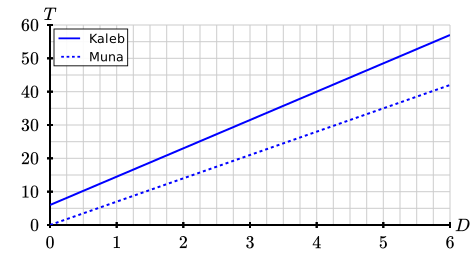
Compare the graphs. Each intercept shows where that line meets the vertical axis. Kaleb’s crosses at 6 minutes, but Muna’s crosses at 0 minutes, at the origin (where the two axes cross).
By the way, Muna’s equation \(T = 7D\) is a direct proportionality because the only thing happening is that the independent variable is being scaled by a proportionality constant, \(k=7\text{.}\) Any direct proportionality fits this template.
To understand what “proportionality” means, recall that Muna can run 2.8 miles in 19.6 minutes. What happens if she goes for a run twice as long? Then she would be running \(2 \times 2.8 = 5.6\) miles. Her time would be
Notice that \(2 \times 19.6 = 39.2\text{.}\) So, it would take her twice the time to run twice the distance. This general idea - that you get twice the value of the dependent variable if you have twice the value of the independent variable - characterizes direct proportions. We sometimes say that Muna’s time is proportional to how far she runs. Nothing special about twice here, as it would take her three times the time to run three times the distance, etc.
which is not quite twice the time, since \(2 \times 29.8 = 59.6 \text{ minutes}\text{.}\) The key is that Kaleb does not stretch twice, only once, for the longer run, so double the distance does not count the 6 minutes again. Kaleb’s equation is not a direct proportionality. Another way to say that is that Kaleb’s time is not proportional to how far he runs. It is a function of how far he runs, yes, but not proportionally so.
In some of these stories, the two variables are directly proportional (intercept = 0). In others, the variables are not directly proportional (intercept is not 0). Your job is to decide which is which.
In each of the following stories, the temperature changes over time. It might be confusing to call either variable \(T\text{,}\) so use \(H\) for the time in hours and \(D\) for the temperature in degrees (°F). In each case, time should be measured from the start of the story.
It was really cold at 8:30 this morning when Raina arrived at the office. Luckily the heating system warms things up very quickly, 4°F per hour. By 11:00 a.m. it was a very comfortable 72°F.
While 72°F is a perfectly good temperature for an office, not so for ballroom dancing. When Raina arrived for her practice at 5:30 that evening, she began to sweat before she even took the floor. Turns out the air conditioner had been running since 4:00 p.m. but it only cools down the room 3°F per hour.
Maryn is very happy. Her interior design business is finally showing a profit. She has logged a total of 471 billable hours at $35 per hour since she started her business. Accounting for start up costs, her net profit now totals $2,194.
Jerome has gained weight since he took his power training to the next level ten weeks ago, at the rate of around 1 pound a week. He now weighs 198 pounds.
Vanessa’s doctor put her on a sensible diet and exercise plan to get her back to a healthy weight. She will need to lose an average of 1.25 pounds a week to reach her goal weight of 148 pounds in a year. Use 1 year = 52 weeks.
Since she has been pregnant, Zoe has gained the recommended \(\sfrac{1}{2}\) pound per week. Now 30 weeks pregnant and 168 pounds, she wonders if she will ever see her feet again.
Each story describes a situation that we are assuming is linear. Decide whether it is proportional, meaning the intercept equals zero. If it is proportional, explain why the intercept would be zero. If it is not proportional, explain what the intercept would mean in the story.
Different runners run at different paces. And take a different amount of extra time to warm-up and/or cool down. The table lists six runners, their training time to run a 5K (rounded to the nearest minute), and their pace (in minutes per mile).
We are interested in each runner’s extra time, but first convert 5K, which is short for 5 kilometers, to miles using \(1 \text{ mile} \approx 1.609 \text{ kilometers}\text{.}\)
The public beach near Paloma’s house has lost about 3′9″
Aside
of beach depth (measured from the dunes to the high water mark) each year due to erosion since they started keeping records 60 years ago. Currently it’s 210 feet deep.
The county is considering filling in sand to offset the erosion, back to the historical mark (60 years ago). How deep was it then? Notice that you need to convert 3′9″ to (decimal) feet first.
The country agrees to start filling in sand when the depth drops below 180 feet. How many (more) years will that take to happen? First estimate the answer using successive approximation. Then set up and solve an inequality to find the answer.
Clyde is loading bricks weighing 4.5 pounds each onto his wheelbarrow. The wheelbarrow weighs 89 pounds when it has 16 bricks in it. (That weight includes both the bricks and the wheelbarrow itself.)
To make cookies it takes a few minutes to prepare the dough. After that it takes 12 minutes per batch to bake in the oven. Last time I made 3 batches of cookies and it took a total of 54 minutes.
How long would it take me to make 10 batches of cookies for the cookie swap? Assume the time to prepare the dough remains the same and only one batch bakes in the oven at a time.