So far we’ve been learning about equations, which are math sentences that involve the equals sign =. We use the equals sign to mean that two things are exactly the same: for instance, if we’re using the letter \(P\) to represent the plumber’s charge, the sentence “\(P = 278.75\)” means that the plumber charged us exactly $278.75. And if \(T\) represents the time the plumber takes, then we can write the general sentence “\(P= 100 + 75T\)” to concisely explain how the plumber figures out his charge based on the time he spends on our job.
In many real-life situations, we don’t care about two things being exactly the same, as long as they meet minimum or maximum requirements.
Aside
For example, if I have a $20 gift card to a restaurant, I don’t care if my order is exactly $20 or if it is $18.74 — either way, the gift card will cover my entire bill.
You’re probably familiar with the useful symbols \(\le\text{,}\)\(\ge\text{,}\)\(\gt\text{,}\) and \(\lt\) that we use to capture this idea. When we use these signs instead of the equals sign =, we have something called an inequality instead of an equation. For instance, if \(B\) is my restaurant bill, I can just write the inequality
\begin{equation*}
B \leq 20
\end{equation*}
to put symbols to the idea that I want my bill to stay under $20.
SubsectionBaking brownies (and setting up inequalities)
In the United States, temperatures for everyday things like the weather or cooking are given in Fahrenheit, denoted °F. In this system, water freezes into ice at 32°F and boils into steam at 212°F. A common setting for room temperature is 68°F whereas average human body temperature is around 98.6°F. And, most importantly, chocolate brownies bake at 350°F.
In the sciences, medicine, and most other countries, temperatures are measured in Celsius, denoted °C.
Aside
For comparison’s sake, it’s useful to know that water freezes at 0°C and boils at 100°C. Not coincidentally - it was set up that way. Room temperature is 20°C whereas now average human body temperature is 37°C. And those brownies?
You may have seen this equation before with fractions in it: \(F = \frac{9}{5}C + 32\text{.}\) Just another way to write the equation, since \(\frac{9}{5} = 9 \div 5 = 1.8\text{.}\) For example, when \(C=100\) we have
What about those chocolate brownies? We are looking for \(F=350\text{.}\) That’s the dependent variable, so you can practice your linear equation solving skills to find the independent variable, \(C\text{.}\) It turns out that chocolate brownies bake at around 177°C.
But, actually, chocolate brownies just need to bake in a moderate oven, which means between 325°F and 375°F. Let’s first figure out which Celsius temperatures mean that the oven temperature is under 375°F. We want to know when
\begin{equation*}
F \le 375
\end{equation*}
Aside
so we have an inequality instead of an equation. Quick vocabulary reminder: equations have equal signs (=). When we have inequality signs (\(\le\text{,}\)\(\ge\text{,}\)\(\gt\text{,}\) or \(\lt\)), it’s called an inequality instead.
But remember, we do also have an equation relating \(F\) and \(C\text{,}\) which is \(F=1.8C+32\text{.}\) This means that \(F\) and \(1.8C+32\) are exactly the same! Whenever two things are the same, you can replace one by the other. So, we can replace \(F\) in our inequality by \(1.8C+32\) to get:
\begin{equation*}
1.8C+32 \le 375
\end{equation*}
We’re looking for values of \(C\) that make the left-hand side a number that’s smaller than, or maybe as large as, 375, but no larger.
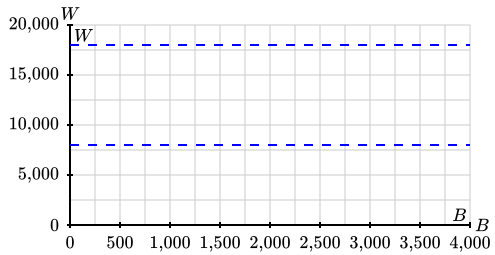
It’s tricky, and requires a bit of practice, to set up inequalities with the inequality sign pointing the right direction. We’ll use the familiar example of the truck hauling bags of grass seed. Remember, the truck weighs 3,900 pounds when it is empty. Each bag of grass seed it carries weighs 4.2 pounds. The equation for the total weight is
\begin{equation*}
W = 3{,}900 + 4.2B
\end{equation*}
where
\begin{align*}
W \amp= \text{ total weight of the loaded truck (pounds)} \sim \text{ dep} \\
B \amp= \text{ number of bags of grass seed (bags)} \sim \text{ indep}
\end{align*}
The state highways have a weight limit: any truck driving on the highway has to be below 18,000 pounds.
We can solve inequalities in much the same way that we solve equations, using the Shoes and Socks Principle. To solve the inequality \(1.8C + 32 \leq 375\) we begin by subtracting 32 from each side to get
To understand why the inequality stays the same when we subtract, think of the inequality as “little” \(\le\) “big.” If one number is smaller than the other, the same will be true if we subtract the same amount from each number. For example, \(18 \le 21\text{.}\) To make it real, suppose I have $18 and you have $21. Then imagine we each buy a movie ticket for $12. I would have \(\$18-\$12 = \$6\) and you would have \(\$21-\$12 = \$9\text{.}\) And still \(6 \le 9\text{.}\)
To understand why the inequality stays the same when we divide, again think of the inequality as “little” \(\le\) “big.” If one number is littler than the other, the same will be true when we divide each number by the same divisor. For example, \(6 \le 9\text{,}\) which we imagined as my having $6 and your having $9 after we each bought a movie ticket. While we’re making up stories, suppose we each have three children who want some money from us for treats. We each divide our remaining cash among our three children, respectively. My kids each get \(\$6\div3 =\$2\) and your kids each get \(\$9\div 3 = \$3\text{.}\) And \(2 \le 3\) still.
There is a bit of caution when solving inequalities. When symbolically solving an equation, any operation you do to each side preserves the equality: start with equal amounts, do the same thing to each, end with equal amounts. But, when symbolically solving an inequality, only some operations you do to each side preserves the inequality: add or subtract from each side or multiply or divide each side by the same (positive) number. But other operations can reverse the inequality.
For example, we can swap sides of an equation, but if we swap sides of an inequality then the direction of the sign reverses. In this brownie example, we want
\begin{equation*}
F \ge 325
\end{equation*}
Remember \(\ge\) stands for greater than or equal to. That’s like “big” \(\ge\) “little.” We can rewrite that inequality as “little” \(\le\) “big,” or equivalently
\begin{equation*}
325 \le F
\end{equation*}
In each case, \(325\) is “little” and \(F\) is “big”. Make sense?
Multiplying or dividing each side of an inequality by a negative number switches the inequality sign as well. Watch out for that with decreasing functions because that’s where the slope is negative. And the number we’re dividing by is actually the slope.
Why does multiplying or dividing by a negative number reverse the inequality sign? It’s because of what \(\lt\) means on a number line: the sentence “\(2 \lt 3\)” is true because 3 is further to the right on a number line than 2.
The moral of this activity: multiplying or dividing by a negative flips the inequality because positive numbers and negative numbers go the opposite direction on the number line.
Remember that the recipe for chocolate brownies says to bake in a moderate oven, between 325°F and 375°F. We just figured out that \(F \le 375\) corresponds to \(C \le 190\text{.}\) But that’s only half of the story. We also wanted \(F \ge 325\text{.}\) While we could solve that inequality separately, it turns out there’s an easier way.
The good news is that we can solve this chain of inequalities all at once using the same steps as before but now being sure to do the same thing to all three sides. “Three sides?” you ask. Yes, “three,” I confirm. Watch how this works. Start with
\begin{equation*}
325 \le F \le 375
\end{equation*}
Using the equation \(F=1.8C + 32\) to replace \(F\text{,}\) we get
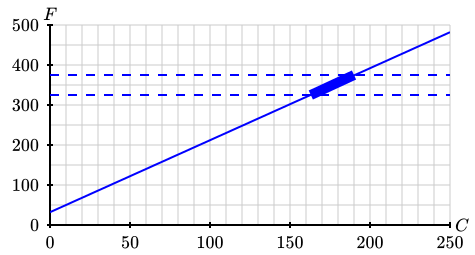
If we graph our linear function \(F = 1.8C+32\text{,}\) we can check our answer for the right temperature range for our brownies. Since we want \(F\) between 325 and 375 we start on the vertical axis and then use the graph to find the right range on the horizontal axis. You can see from the highlighted region that our answer is reasonable. Now, who wants brownies?
The airplane might be asked to go into a holding pattern (that means flying in a circle instead of landing) when it is between 6,000 and 14,000 feet up. When will the plane be in that altitude range?
Anthony and Christina are trying to decide where to hold their wedding reception.
Aside
For each possible site, write an equation using \(T\) for the total cost of their wedding reception (in dollars) and \(G\) for the number of guests. Then set up and solve an inequality to calculate the number of guests Tony and Tina can afford on their $8,000 budget.
One variety of blueberry plant yields an average of 130 blueberries per season but there is quite a bit of variability from plant to plant. One measure of this variability is the standard deviation, which is approximated at 16.4 berries. Given a plant yielding \(B\) blueberries, we can calculate how usual or unusual that is by computing its (standard) z-score using the equation
\begin{equation*}
Z = \frac{B-130}{16.4}
\end{equation*}
For example, a plant yielding \(B=130\) blueberries has z-score of 0. A plant yielding \(B = 138\) blueberries has z-score of
You’re planning a trip to Norway over Christmas and have heard it’s will be around 10°C. What sort of jacket will you need? Convert to Fahrenheit to decide.
You want to explain to your Norwegian hosts that back in Minnesota this time of year temperatures can range between -20°F and 40°F. Express this range in Celsius instead. Set up and solve a chain of inequalities.
Your Norwegian hosts ask about the temperature in Minnesota during the summer. You explain that summer temperatures typically range from 55°F and 105°F. Express this range in Celsius instead. Set up and solve a chain of inequalities.
The water level in the local reservoir has been dropping steadily.
Aside
In fact,
\begin{equation*}
D = 47-1.5W
\end{equation*}
where \(D\) is the depth of the water (in feet) after \(W\) weeks. Any depth below 20 feet is considered dangerously low. When will that happen, assuming no change in the weather? Set up and solve an inequality. And, check your answer.
A manufacturer makes family-sized bags of potato chips, advertised as containing 200 grams each. In fact it’s difficult to control the exact weight of a bag of potato chips, so it varies. The standard deviation is rather high, about 3.8 grams per bag. The company would rather have bags too heavy than too light, lest they be accused of false advertising, so their average bag actually weighs 207 grams. It turns out that approximately 97% of all bags of chips weigh 200 grams or more. We can compute the standard \(Z\)-score of a given bag of chips weighing \(B\) grams using the equation
\begin{equation*}
Z = \frac{B-207}{3.8}
\end{equation*}
What is the \(Z\)-score for a bag of potato chips weighing the advertised 200 grams? Remember above average \(Z\)-scores are positive and below average \(Z\)-scores are negative, so your answer should be negative.
About \(\tfrac34\) of all bags of chips will have \(Z \ge -0.67\text{.}\) What weight bag has \(Z\)-score of \(-0.67\text{?}\) Set up and solve an inequality.
The cost of vacation to Cork, Ireland from the Minneapolis/St. Paul airport for two people is given by the equation formula
\begin{equation*}
C = 2{,}828 + 310N
\end{equation*}
where \(C\) is the total cost in U.S. dollars and \(N\) is the number of days. Ciara wants to take her boyfriend Seamus to Cork to meet Ciara’s grandmother.