A family with one full-time worker earning minimum wage cannot afford the local fair-market rent for a two-bedroom apartment anywhere in the United States. Even families earning above minimum can struggle to rent an apartment for less than 30% of their income. As a result, many people need affordable housing. There are various local, state, and federally funded programs as well as non-profit agencies working to increase availability.
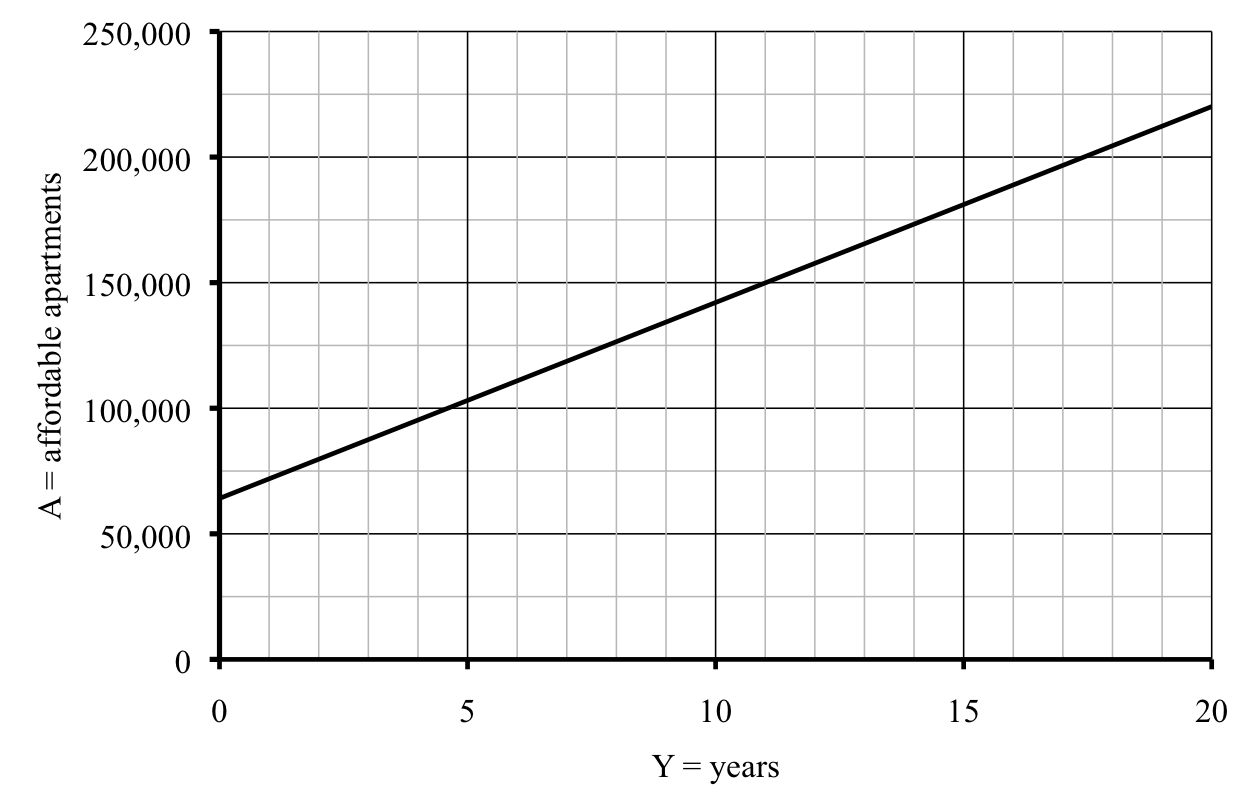
In our city there are about 64,100 apartments considered affordable. So the city partnered with local developers to build 7,800 more apartments each year. Our variables are
\begin{align*}
A \amp= \text{ affordable housing (apartments) } \sim \text{ dep} \\
Y \amp= \text{ time (years from now) } \sim \text{ indep}
\end{align*}
Quick recap. A function is linear if its graph is a straight line, and nonlinear otherwise. The rate of change measures the steepness of the graph for any function, but a straight line is the same steepness everywhere, so the rate of change, or slope of a line is constant. Our example is linear because the slope of apartments per year is constant. Our starting or fixed amount is the intercept. In our example it’s apartments. The dependent variable and the intercept always have the same units - apartments in our example. But
\begin{equation*}
\text{units for slope} =\frac{\text{units for dep}}{\text{units for indep}}
\end{equation*}
so, in our example slope is measured in apartments per year. These units can help you identify the slope and intercept in a story - so keep a look out.
How many years will it take the city to reach 150,000 apartments at this rate? After ten years, for example, there would still not be enough affordable apartments because
As expected, the graph is a straight line. And we see that the city should reach its goal of 150,000 affordable apartments in 12 years, or slightly before then.
A solar heating system costs approximately $30,000 to install and $150 per year to run. By comparison, a gas heating system costs approximately $12,000 to install and $700 per year to run. (Story also appears in 4.2.10)
If you install and run a solar heating system, how many years can you use it before it costs the same as installing and running a gas heating system for 30 years (your answer to part (a))? Set up and solve an equation.
Since a very popular e-book reader was released, the price has been decreasing at a constant rate. A blogger developed the following equation representing the price \(E\) of the e-book reader \(T\) months since it was released:
Sareth decided to purchase a e-book reader when the price fell below $100. How many months after its release did the price of the e-book reader fall below that level? Set up and solve an inequality.
If you can believe what you read in blogs, the manufacturer will soon be giving away the e-book reader for free, since they make money on the e-book sales themselves. How many months after it was released would that happen, according to our equation? Set up and solve an equation.
Can you tell from the table which of these functions are linear? Use the rate of change to help you decide. Remember that these numbers may have been rounded.
Plumbers are really expensive, so I have been comparing prices. James charges $50 to show up plus $120 per hour. Jo is just getting started in the business. She charges $45 to show up plus $55 per hour. Mario advertises “no trip charge” but his hourly rate is $90 per hour. Not to be outdone, Luigi offers to unclog any drain for $150, no matter how long it takes. For each plumber, the table lists the corresponding equation and several points. In each equation, the plumber charges $\(P\) for \(T\) hours of work. (Story also appears in 2.1.5)
We looked at the city’s plan to increase the number of affordable apartments. From a current estimate of 64,100 apartments classified as “affordable,” they hoped to build 7,800 per year. At that rate, they can reach a total of 150,000 apartments in 12 years.
Things change. Revised estimates call for only 6,200 new apartments each year. At that rate, when will the city reach the 150,000 apartments goal? Using the same variables as in this section, set up and solve an equation.
More bad news. The definition of “affordable” has changed again, so the new count shows only 48,700 apartments on the list. And still only 6,200 new apartments each year. Now when will the city reach the 150,000 apartments goal? Set up and solve an equation.
In light of the new definition and, consequently, only 48,700 apartments currently on the list, the city has received additional funding to up the number of apartments built each year. They would like to return to their goal of having 150,000 affordable apartments in 12 years. How many apartments do they need to add each year to reach that goal? Figure out the answer however you like, but check that it works.
At a local state university, the tuition each student pays is based on the number of credit hours that student takes plus fees. The university charges $870 per credit hour plus a $560 fee. The fee is paid once regardless of how many credits are taken.
Can you tell from the table which of these functions is linear? Use the rate of change to help you decide. Remember that numbers may have been rounded.
The temperature in Minneapolis was 40 degrees at noon yesterday but it dropped 3 degrees an hour in the afternoon. Earlier we found the temperature, \(T\) in °F depends on the time, \(H\) hours after noon according to the equation